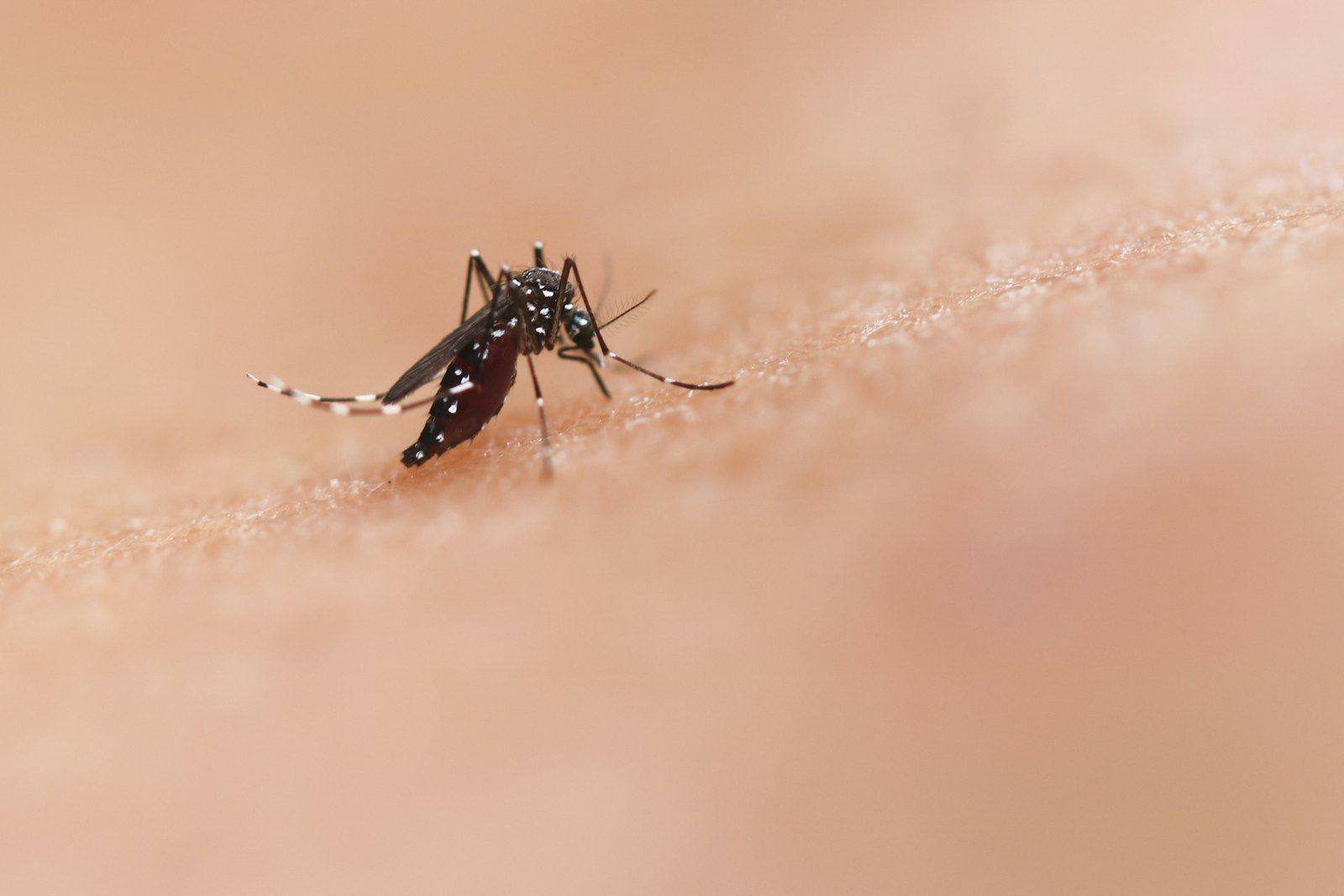
A small black-and-white mosquito that bites in daylight, breeds in a bottle-cap of water and is now settled across much of Europe. Here is how to identify Aedes albopictus, what a tiger mosquito bite does and does not mean, and the four things that actually keep it off you.
The Asian tiger mosquito (Aedes albopictus) is small and black-and-white, and it bites during the day. It has settled across much of southern and central Europe and is still moving north. It is easy to identify, it breeds in a bottle-cap of standing water close to where people live, and its bite is usually just an itchy welt. It matters more than most mosquitoes because it can carry dengue, chikungunya and Zika (European Centre for Disease Prevention and Control, Aedes albopictus factsheet).
We will say the disease part plainly, once, and then keep it in proportion. The aim is not to alarm anyone. It is to know exactly what to do, and most of what to do is dull, cheap and effective.
How to recognise a tiger mosquito
You do not need a microscope. The tiger mosquito advertises itself:
- Size: small, noticeably smaller than the large brown house mosquitoes many people picture (ECDC factsheet).
- Colour: deep black, not brown, with bright white markings. A single clean white stripe runs down the centre of its back and head.
- Legs: the giveaway. Each leg carries crisp white bands, so the insect looks striped, which is where "tiger" comes from.
- When it bites: during the day. Unlike the night-flying mosquitoes that whine around a bedroom, Aedes albopictus bites in daylight hours (ECDC factsheet).
- Where it bites: low and often. It tends to go for ankles, calves and feet, and it is persistent rather than shy.
If a small, striped mosquito bites your ankles on a balcony at four in the afternoon, you have almost certainly met the tiger.
Q: Is a tiger mosquito the same as a normal mosquito?
A: It is a distinct species, Aedes albopictus, not a variant of the common house mosquito (Culex). The practical differences are that it bites in the day rather than at night, it targets the lower legs, it rarely travels far from where it hatched, and it is a competent carrier of dengue, chikungunya and Zika. The common night-biting Culex mosquito is the one linked to West Nile virus instead.
Why the tiger mosquito is now a European resident
For most of the last century this was a tropical and subtropical insect. It is not any more. Peer-reviewed modelling published in Global Change Biology by Arianna Radici, Cyril Caminade and colleagues tracked its spread across France and western Europe. It arrived in a single French departement in 2004 and now advances between 10 and 40 kilometres a year. The climate of Paris, Vienna, Frankfurt, London and Zagreb is now warm enough for it to establish (Radici et al., Global Change Biology, 2025). The European Commission flagged the same five-city shift in January 2026 (European Commission, Environment).
What lets it stay is one unglamorous trait: unlike its purely tropical cousin Aedes aegypti, the tiger mosquito tolerates a cool European spring. That single tolerance is what moves the line north.
You can see how far the range has reached in your own region on the tiger mosquito threat map, which tracks Aedes albopictus establishment and outbreak history across Europe.
What a tiger mosquito bite actually means
Here is the part that gets distorted, in both directions, online.
A tiger mosquito bite is, in the overwhelming majority of cases, exactly what it looks like: a small, itchy, raised welt that fades over a few days. The itch is not venom. It is your own immune system reacting to proteins in the mosquito's saliva, the same mechanism behind every mosquito bite. In some people, especially children, that reaction is large and dramatic, a hot swelling several centimetres across, a recognised condition informally called Skeeter syndrome. Uncomfortable is not the same as dangerous. We cover the itch, the swelling and the genuine red-flag symptoms in the companion guides on why mosquito bites itch and how to stop it and on Skeeter syndrome.
The reason this species gets its own guide is the smaller, real risk sitting behind the ordinary bite: Aedes albopictus can transmit dengue, chikungunya and Zika (ECDC factsheet). That sentence needs its proportion kept, so here it is in full.
For local transmission to happen, two things have to line up in the same place. First, a person already carrying the virus, usually after travel from a region where it circulates. Second, an established population of tiger mosquitoes to bite that person and then bite someone else.
A tiger mosquito is not born infected. Most tiger mosquitoes in Europe carry nothing at all. When clusters do appear, they have been detected and recorded. In 2025, France reported locally acquired chikungunya cases across eight regions and Italy across eight regions (ECDC historical local transmission data).
So the honest summary is neither "a plague is coming" nor "there is nothing to think about". The bite itself is almost always trivial, and the disease risk is real but currently low and actively managed. The same few cheap actions reduce both.
Q: What happens if a tiger mosquito bites you?
A: Nearly always, an itchy welt that clears in a few days. Only rarely does a tiger mosquito carry a virus, and only when it has previously bitten an infected person. Watch for high fever, severe joint pain, a widespread rash or persistent vomiting in the week or two after a bite, particularly following travel, and see a doctor if they appear. Otherwise, treat it as an ordinary bite.
The four things that actually keep it off you
Because the tiger mosquito's whole life is lived close to home, the household has more control over it than over almost any other biting insect. It rarely flies more than a couple of hundred metres from where it hatched, which means the mosquito biting you on a balcony was very probably born on that balcony (ECDC factsheet). Four things, in order of impact:
1. Empty the standing water. This is the single most useful thing you can do, and it is free.
The tiger mosquito breeds in tiny volumes of water: a plant saucer, a blocked gutter, a watering can, a forgotten bucket, the folds of a rain cover, the tray under an air-conditioning unit. A bottle-cap is enough. It does not use ponds or streams. Once a week, walk your balcony, terrace or garden and tip out everything holding water, then scrub the container, because eggs stick to the sides above the waterline. Remove the nursery and you remove the next generation before it can bite anyone. It costs nothing.
2. Put a physical barrier between the mosquito and your skin.
A barrier is the one method that neither wears off nor sprays chemicals into the air you breathe. A fine-mesh screen on a window or door, or a correctly specified net over a bed or a pram, keeps the insect out entirely. The mesh has to be genuinely fine: the tiger mosquito is small, and a coarse weave built for larger night-flying mosquitoes can let it straight through. That failure is covered in our guide to telling a net that works from one that only looks like it does.
In the European Union, any net that carries an insecticide is a treated biocidal product. Placing one on the market legally requires authorisation under the EU Biocidal Products Regulation. A net protects a bed, a balcony or a garden enclosure. It does not drain a breeding site, which is why step one comes first.
3. Use a proper repellent on the skin a barrier cannot cover, and know what it is for.
Repellents containing DEET or picaridin work. The US Environmental Protection Agency lists both as registered skin-applied repellent ingredients (US EPA, skin-applied repellents). In head-to-head trials, DEET gave the longest complete protection (Fradin and Day, New England Journal of Medicine, 2002). Because the tiger mosquito bites low, apply to ankles, calves and feet, not just arms. A repellent is a supplement, not a barrier: its protection ends the moment you forget to reapply. It is the top-up for the daylight hours a screen cannot cover, not a replacement for one.
4. Skip the things that only look like protection.
The mosquito-protection aisle is full of products sold as adequate protection that are not. Citronella and scented candles deliver scent, not a meaningful outdoor shield. Burning coils indoors trades biting insects for fine particulate in the air you breathe.
Plug-in vaporisers release a continuous, poorly characterised chemical load into sealed rooms. The uncertified nets sold across generic marketplace listings often have a mesh too coarse for this exact species, with no durability rating and no authorisation number. None of these is a scandal on its own; together they are the reason so many people feel protected and still get bitten. We set out the evidence, category by category, in do citronella candles work and in the guide to uncertified marketplace nets. The rule is simple: spend your effort on the water and the barrier first, because those are the measures that work.
What we know
The single question
The tiger mosquito is not leaving Europe. That is settled. What is not settled is how much of your summer it affects, and that is largely in your hands, because it lives and breeds within a short distance of where it bites you. Tip out the water, put a real barrier where it counts, top up with a proper repellent on exposed skin, and stop paying for the things that only look like protection. Do those four, in that order, and the mosquito that spread across a continent still has to get past a screen to reach you.
Sources: ECDC Aedes albopictus factsheet | Radici et al., Global Change Biology 2025 | European Commission, Environment, 2026 | ECDC historical local transmission data | Fradin and Day, NEJM 2002 | US EPA, skin-applied repellents | EU Biocidal Products Regulation 528/2012
This article is general information, not medical advice. For travel health, disease risk or symptoms, consult a qualified healthcare professional.