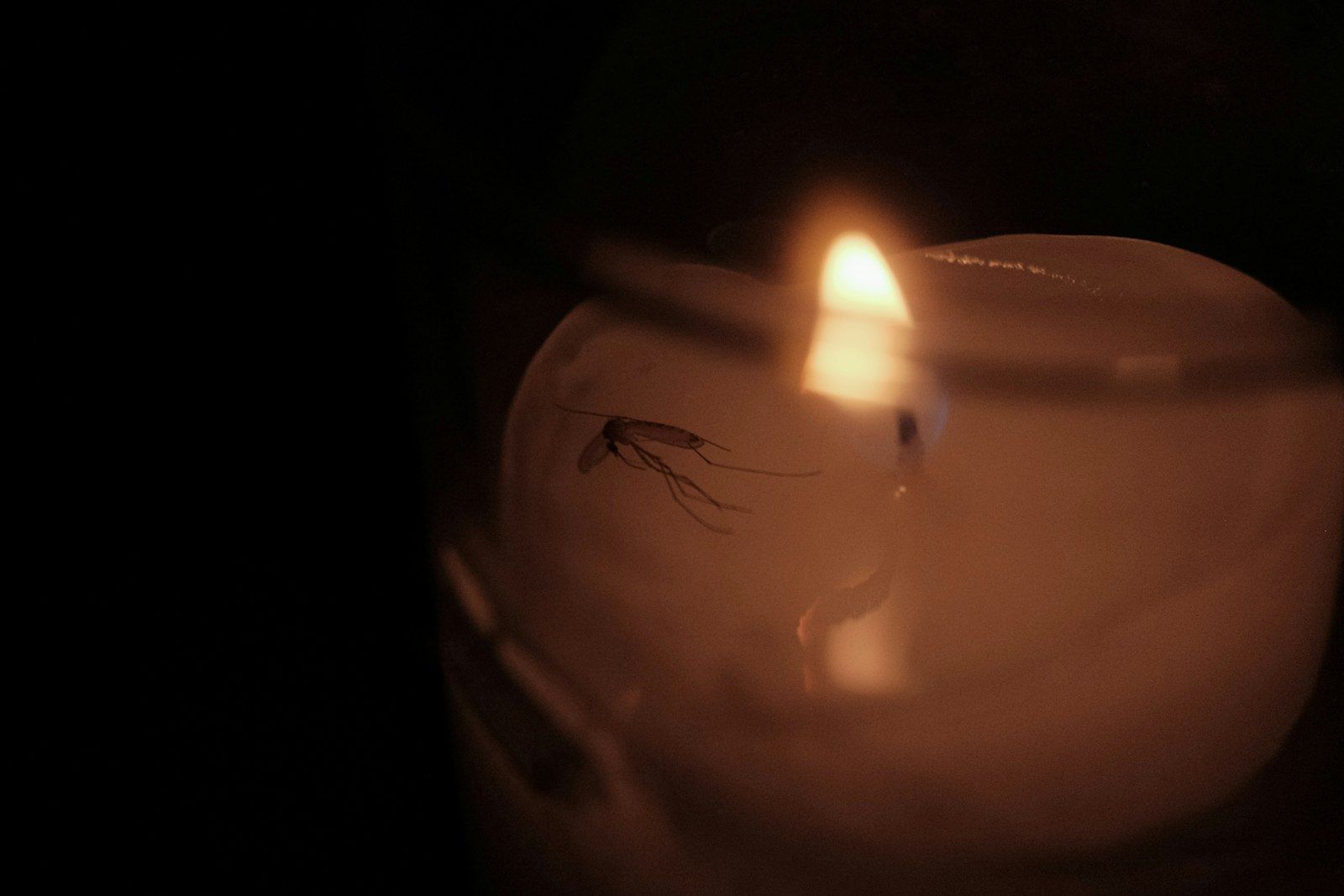
The honest answer is a little, at arm's length, in still air. As real outdoor protection, no. Here is what the peer-reviewed evidence says about citronella, coils and repellents, and what actually keeps mosquitoes off you.
You have almost certainly lit one. A warm evening, a table outside, a squat green candle with a citrus smell, and a quiet hope that the buzzing will keep its distance. The candle is pleasant. The hope, mostly, is misplaced.
Let us be plain, because someone should be: as a piece of ambience, a citronella candle is lovely. As protection from mosquitoes, it is close to decorative. That gap between what it is sold as and what it does is the thing worth talking about.
What the evidence actually shows
The most useful study to reach for is Fradin and Day (2002), in the New England Journal of Medicine, which compared a range of mosquito repellents head to head and measured how long each kept biting mosquitoes off the skin. Its findings are consistent and unglamorous. Products based on DEET protected longest by a wide margin. The plant-oil botanicals, the family citronella belongs to, sat near the bottom: they offered some effect, but it was brief and modest.
That is the honest shape of it. Citronella oil is not nothing. In a controlled setting, close to the source, with the air still, it can nudge mosquitoes away for a short while. The trouble is that a candle on a garden table is none of those things. The scent disperses in the open air, a breeze scatters it, and in controlled testing a citronella candle had no effect on mosquito attraction a metre away (Rodriguez et al., Journal of Insect Science, 2017). Your ankles are on their own.
Ineffective is not the same as harmful
It matters to keep the categories straight, because the mosquito aisle blurs them into one vague sense that everything is either magic or poison. It is neither.
A citronella candle is simply ineffective as outdoor protection. It will not hurt you. Burn it for the smell and the light, enjoy it, and expect nothing more.
That is a different problem from the mosquito coil, the smouldering spiral sold for the same purpose. Peer-reviewed measurement found that burning a single coil releases the same mass of fine particulate matter (PM2.5) as burning between 75 and 137 cigarettes. Indoors, that is a genuine respiratory concern, not a matter of taste. Ineffective and harmful are not the same word, and we will not pretend they are.
And it is different again from the aerosol repellents, DEET and picaridin, which sit at the effective end. These work. Fradin and Day ranked DEET highest for a reason. The honest critique of them is not that they fail; it is that they are a supplement worn on the skin, they wear off, and their protection ends the moment you forget to reapply. They are a useful tool, not a barrier and not a whole system.
Three products, three different truths. Anyone selling all of them with the same confident promise is not being straight with you.
Why the promise persists
None of this is a secret to the people selling candles. The comforting smell does real work on the buyer: it feels like something is happening, and a product that engages your senses is easy to believe in. The label leans on that. "Citronella" has become shorthand for protection in a way the evidence never earned.
We are not going to be polite about that. Selling ambience as if it were a shield, to people who then sit outside genuinely believing they are covered, is the small dishonesty this whole category runs on. It is quiet, it is widespread across brands and shops and marketplaces, and it is worth naming for what it is.
So what actually keeps mosquitoes off you
Here is the part that helps, and it is refreshingly boring.
The mode of action that holds up is a physical one: put a barrier between you and the mosquito. A well-made mesh net over a bed, a balcony, or a garden enclosure does not wear off, does not need reapplying, and does not depend on the wind. There is nothing to inhale and no residue on your skin. What matters is that the mesh is fine enough for the mosquitoes in your region, that the net is unbroken, and that it is actually used, closed and tucked rather than left gaping. The Asian tiger mosquito, now established across much of southern Europe, is relatively small. A fine mesh stops it.
A net does not do everything, and we will say so out loud. It protects a space; it does not drain the puddle down the road where the mosquitoes breed. For time spent out in the open, away from any enclosure, a proper repellent like DEET or picaridin, applied and reapplied, is the sensible supplement. The base layer is the barrier. The repellent is the top-up.
Worth stating clearly, because the aisle muddles this too: a good untreated net is real protection. Protection does not require chemistry. A correctly rated, intact, well-used physical barrier keeps mosquitoes off you whether or not it carries a treatment. Where a net is treated, one WHO-recommended active bound into the fibre reinforces the barrier at the point of contact. The failures the market hides are the wrong mesh, poor durability, and no certification, not the absence of a chemical.
The short version
Do citronella candles work? Barely, and not where it counts. Light one for the evening if you like the smell. Do not light one instead of protecting yourself.
The stakes here are real without needing to be exaggerated. Vector-borne diseases kill more than 700,000 people a year worldwide, most of them through malaria, which mosquitoes carry, and dengue can be fatal too. That is precisely why honesty about what protects you is not a marketing flourish; it is the least you are owed. A candle is a candle. Protection is a barrier you can rely on, used properly, backed by a repellent when you are out in the open. Everything in between is mostly the smell of citrus and the comfort of thinking you are covered.
Sources: Fradin and Day 2002, NEJM, Comparative Efficacy of Insect Repellents | Liu et al. 2003, Environmental Health Perspectives, Mosquito coil emissions | WHO, Vector-borne diseases | ECDC, Aedes albopictus | Rodriguez et al. 2017, Journal of Insect Science, repellent devices and a citronella candle
Byline: Mosticare Editorial.
This article is general information, not medical advice. For travel health, disease risk, or symptoms, consult a qualified healthcare professional.
This article is general information, not medical advice. Ask a doctor or pharmacist about your own health.