(01) The Foundation

Who we are, and the oath that holds us to it.

The institution behind the work: what it is, what it promises, and who answers for it.

Mosticare Foundation

We exist to rid the world of mosquito-borne disease.

The independent global foundation for mosquito diseases and vector control, through honest information, real-time surveillance, and a promise to never poison the nature we defend.
Scroll · or move sideways
The Journal

Fresh from the field

New research, outbreak dispatches, and field notes, published continuously.

Chemical-free family mosquito protection: which physical barrier fits which household

A physical barrier stops a mosquito by exclusion, with zero chemistry on a child's skin and nothing released into the air of the room. This is the household guide to matching the barrier to the person: an untreated canopy or cot net for babies and toddlers, an untreated bed or travel net for pregnant women, and, for older children and adults heading to higher-risk destinations, a permethrin-treated net authorised under the EU Biocidal Products Regulation. Here is how the three choices differ, what the labels are allowed to say, and why the youngest and the pregnant sit firmly on the untreated side of the line.

Mosquito protection in pregnancy: why a physical barrier is the zero-chemical answer, and why the bite is still worth preventing

Regulators do not tell pregnant women to avoid insect repellent. The CDC, ANSES and the BfR all consider EPA and BPR registered repellents (DEET, picaridin, IR3535) acceptable in pregnancy when used as directed. But most expectant parents would rather not put anything on the skin at all, and the mosquito-borne infections that matter in pregnancy, above all Zika, are exactly the ones worth preventing. A physical barrier resolves both pressures at once: full protection, with zero chemicals on skin or in the air.

40 degrees, open windows, mosquitoes in the bedroom: the no-chemical answer for European heatwave nights

The first heat dome of July 2026 closed windows across France for a week and the second one is forecast for the second half of the month. When the bedroom reopens the window, the female Aedes albopictus in the garden finds the plume of carbon dioxide from a sleeping adult within minutes. The structural answer for the European heatwave night is older than the heat: an untreated bedroom canopy net, hung from a single point above the bed, breathable mesh that holds the mosquito out while the window stays open and the air keeps moving. No permethrin, no plug-in vapour, no coil, no DEET on the sleeping adult's skin.

Europe's 2026 West Nile virus season has formally opened: the ECDC weekly has gone standalone, Romania has entered the platform, and the pan-European transmission window is now structurally open

The European Centre for Disease Prevention and Control published its first standalone weekly West Nile virus case-data report of the 2026 EU/EEA season on 2 July 2026 at 12:00, with data current to 1 July 2026. The cumulative totals since 1 January 2026 reached 6 cases across 3 countries: Italy with 3, Romania with 2, and North Macedonia with 1. Romania's entry onto the platform, in a historically recurring WNV reporting country in central-eastern Europe, is the structural signal that the pan-European WNV transmission window has formally opened for the 2026 season. The consumer-protection layer remains the load-bearing protection during the in-season autochthonous-transmission window.

Wild foxes and stone martens in the Netherlands are testing positive for West Nile and Usutu virus: a One Health sentinel study extends the European mosquito-borne flavivirus map into the north-west, and the consumer-protection reading is that bite prevention is the layer available now

Dutch researchers report Usutu virus RNA in nine of 818 wild carnivores, and West Nile or Usutu antibodies in red foxes and stone martens, with viral sequences clustering with local birds and mosquitoes (npj Viruses, Erasmus MC and Utrecht University, PMID 42436284, online 11 July 2026). The authors argue wild mammals may act as sentinel hosts for both mosquito-borne flaviviruses, extending the European surveillance map into the north-west beyond the Mediterranean-heavy footprint ECDC recorded across five countries and eleven areas as of 8 July 2026. It is a One Health signal about how these viruses circulate, not an alarm: West Nile is endemic in Europe, most infections are mild or symptomless, and because there is no licensed human vaccine and no specific antiviral, bite prevention through physical barriers, repellents, and standing-water source reduction is the reliable layer at the human-vector interface.

West Nile is usually mild, but its neuroinvasive form can be fatal: an Italian clinical review puts the case-fatality of the neuroinvasive form as high as 17 percent with no licensed treatment, while the US season spreads county by county, and the consumer-protection reading is that bite prevention is the layer available now

A clinical review from Rome's Spallanzani Institute frames West Nile virus as a climate-sensitive flavivirus now endemic in Europe, with Italy's Lazio region an emerging epicentre (Reviews in Medical Virology, PMID 42431607). It notes that fewer than 1 percent of infections become neuroinvasive, but that this severe form carries a case-fatality rate as high as 17 percent, and that no antiviral or human vaccine is licensed, so care remains supportive. The review lands as the US 2026 season spreads county by county, with two new human cases in Shelby County, Tennessee, and virus-positive mosquitoes in Berkshire County, Massachusetts, on top of the highest early-season CDC count in 22 years. The message is sober, not alarmist: most West Nile infections are mild or symptomless, but the rare neuroinvasive form is serious, and because there is no vaccine or specific antiviral, bite prevention through physical barriers, correct repellent use, and standing-water source reduction is the reliable layer at the human-vector interface.

The category we repudiate

Someone has to be blunt about snake oil. It is us.

The mosquito-protection aisle is full of products that range from ineffective to actively harmful, sold as if they were adequate protection. The public has a right to know the difference, and a right to a credible alternative.

Read the evidence
Sold as protection
Gas-emitting coils Indoor-air harm
Pyrethroid smoke devices

Burning one coil indoors emits fine particulate (PM2.5) on the order of dozens of cigarettes. The clearest case of a product that harms the air you breathe.

Liu et al. 2003 · Environ. Health Perspect.
Plug-in diffusers Unquantified exposure
Prallethrin vaporisers

A volatile insecticide released continuously into sealed rooms. Prallethrin is an EU candidate for substitution, and cumulative human exposure is poorly characterised.

Reg. (EU) 2024/2576 · prallethrin PT18
Scented candles Marginal efficacy
Citronella and essential-oil blends

A marginal repellent effect at close laboratory distances, and no meaningful protection in real outdoor conditions. Ambience sold as protection.

Fradin & Day 2002 · NEJM
Aerosol repellents Effective, not a barrier
DEET and picaridin

These work: DEET and picaridin are effective repellents. But they are a supplement, not a barrier. Skin and airway exposure, residue on clothing and bedding, and protection that ends the moment you forget to reapply.

Fradin & Day 2002 · NEJM
Uncertified marketplace nets No certification
Generic listings on Temu, AliExpress, Wish, unbranded Amazon

The purest illusion of protection: mesh often too coarse for the tiger mosquito, no EU BPR authorisation, no durability rating, sometimes claiming a treatment they do not carry. The appearance of protection over an open door.

No EU BPR authorisation · no durability rating
Mosticare LLINs
Physical barrier
No inhalation. No skin residue.

A textile mesh between human and vector. The mode of action that medicine keeps returning to.

Fabric-bound treatment
One active ingredient: permethrin

A single WHO-recommended active, permethrin, bound into the fibre, one formula not two. EU BPR authorised (permethrin, EU-0026815-0000). No leaching into air, water, or skin over the product lifetime.

Built to WHO standards
Category: long-lasting insecticidal net

Independent efficacy and safety testing against WHO target entomological endpoints. Traceable by batch.

Years, not hours
A net outlasts every spray

Aerosols wear off in hours and depend on you reapplying them. A long-lasting impregnated net keeps working for years, every Mosticare net for a minimum of three.

Measured limitation
Not a substitute for environmental control

A net protects a bed, a balcony, a garden enclosure. It does not drain a breeding site. We say so because it is true.

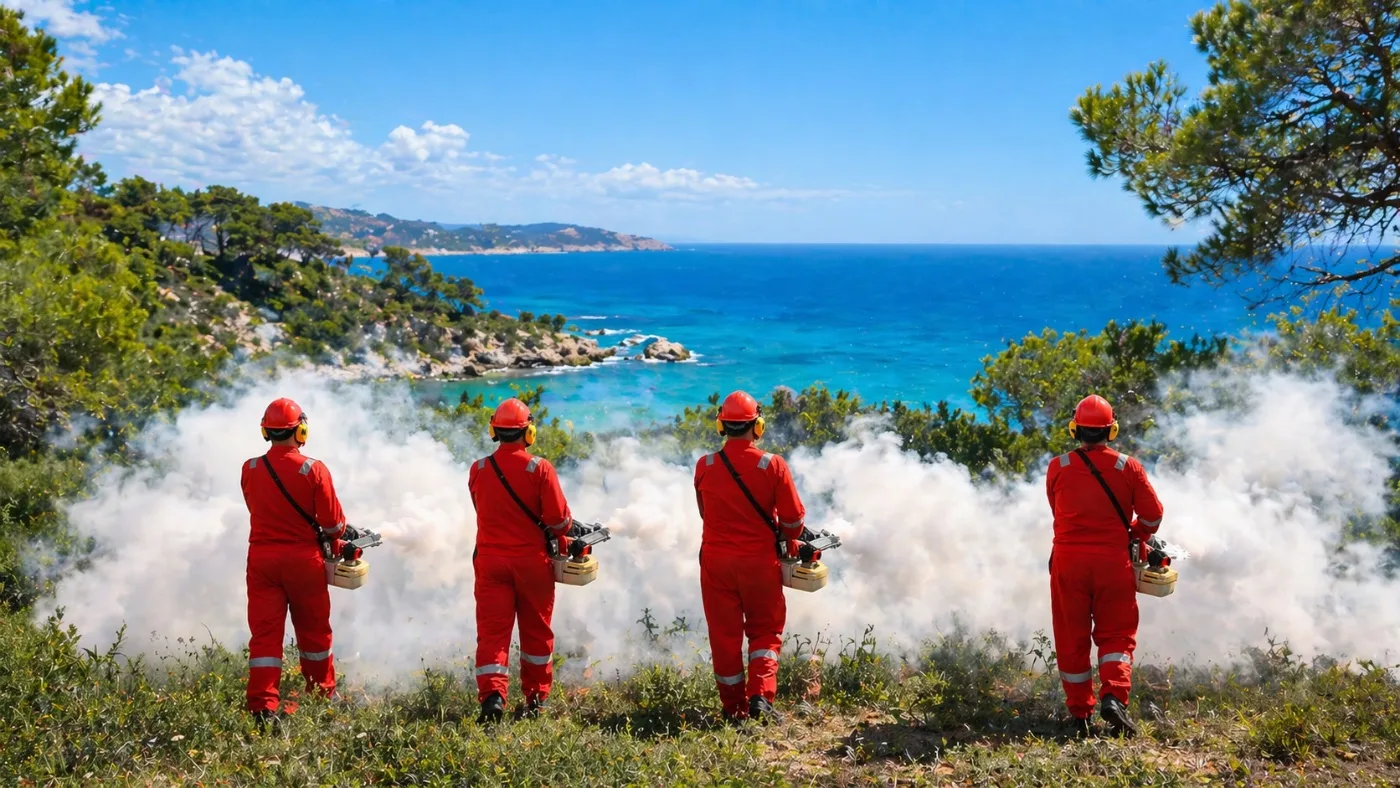
Pest-control workers in red coveralls releasing thick clouds of insecticide fog from backpack sprayers along a Mediterranean cliffside.
Field note
Mainland France's largest fogging operation
Antibes, French Riviera · September 2025
Spraying the Mediterranean with insecticide is not a strategy. It is an admission of failure.Protection is a barrier, not a toxic fog.

Mosquitoes are the basis of the food chain, we need them.

Primum non nocere
The environment counts as a patient.

We measure success by what does not happen. The bite that never lands, the fever that never arrives, the forest that is never poisoned to protect the people who live in it.

(03) Impact

The numbers we exist to lower.

700K+

Deaths a year from vector-borne disease worldwide (WHO).

2.9B

Insecticidal nets distributed globally to date (WHO).

3

Continents under active Mosticare surveillance.

0

Tolerance for harm to the ecosystems we defend.

Making our homes safe without destroying theirs.

The Mosticare Podcast

The first podcast in the world only about mosquitoes.

Every week, we explain why mosquitoes are a necessary piece of Nature to protect, while giving you travel hacks on how to avoid them to the maximum. Find them here:

Tune in every Sunday
(01) The Foundation

Who we are, and the oath that holds us to it.

The institution behind the work: what it is, what it promises, and who answers for it.

Mosticare Foundation

We exist to rid the world of mosquito-borne disease.

The independent global foundation for mosquito diseases and vector control, through honest information, real-time surveillance, and a promise to never poison the nature we defend.

Scroll · or move sideways
The Journal

Fresh from the field

New research, outbreak dispatches, and field notes, published continuously.

Chemical-free family mosquito protection: which physical barrier fits which household

A physical barrier stops a mosquito by exclusion, with zero chemistry on a child's skin and nothing released into the air of the room. This is the household guide to matching the barrier to the person: an untreated canopy or cot net for babies and toddlers, an untreated bed or travel net for pregnant women, and, for older children and adults heading to higher-risk destinations, a permethrin-treated net authorised under the EU Biocidal Products Regulation. Here is how the three choices differ, what the labels are allowed to say, and why the youngest and the pregnant sit firmly on the untreated side of the line.

Mosquito protection in pregnancy: why a physical barrier is the zero-chemical answer, and why the bite is still worth preventing

Regulators do not tell pregnant women to avoid insect repellent. The CDC, ANSES and the BfR all consider EPA and BPR registered repellents (DEET, picaridin, IR3535) acceptable in pregnancy when used as directed. But most expectant parents would rather not put anything on the skin at all, and the mosquito-borne infections that matter in pregnancy, above all Zika, are exactly the ones worth preventing. A physical barrier resolves both pressures at once: full protection, with zero chemicals on skin or in the air.

40 degrees, open windows, mosquitoes in the bedroom: the no-chemical answer for European heatwave nights

The first heat dome of July 2026 closed windows across France for a week and the second one is forecast for the second half of the month. When the bedroom reopens the window, the female Aedes albopictus in the garden finds the plume of carbon dioxide from a sleeping adult within minutes. The structural answer for the European heatwave night is older than the heat: an untreated bedroom canopy net, hung from a single point above the bed, breathable mesh that holds the mosquito out while the window stays open and the air keeps moving. No permethrin, no plug-in vapour, no coil, no DEET on the sleeping adult's skin.

Europe's 2026 West Nile virus season has formally opened: the ECDC weekly has gone standalone, Romania has entered the platform, and the pan-European transmission window is now structurally open

The European Centre for Disease Prevention and Control published its first standalone weekly West Nile virus case-data report of the 2026 EU/EEA season on 2 July 2026 at 12:00, with data current to 1 July 2026. The cumulative totals since 1 January 2026 reached 6 cases across 3 countries: Italy with 3, Romania with 2, and North Macedonia with 1. Romania's entry onto the platform, in a historically recurring WNV reporting country in central-eastern Europe, is the structural signal that the pan-European WNV transmission window has formally opened for the 2026 season. The consumer-protection layer remains the load-bearing protection during the in-season autochthonous-transmission window.

Wild foxes and stone martens in the Netherlands are testing positive for West Nile and Usutu virus: a One Health sentinel study extends the European mosquito-borne flavivirus map into the north-west, and the consumer-protection reading is that bite prevention is the layer available now

Dutch researchers report Usutu virus RNA in nine of 818 wild carnivores, and West Nile or Usutu antibodies in red foxes and stone martens, with viral sequences clustering with local birds and mosquitoes (npj Viruses, Erasmus MC and Utrecht University, PMID 42436284, online 11 July 2026). The authors argue wild mammals may act as sentinel hosts for both mosquito-borne flaviviruses, extending the European surveillance map into the north-west beyond the Mediterranean-heavy footprint ECDC recorded across five countries and eleven areas as of 8 July 2026. It is a One Health signal about how these viruses circulate, not an alarm: West Nile is endemic in Europe, most infections are mild or symptomless, and because there is no licensed human vaccine and no specific antiviral, bite prevention through physical barriers, repellents, and standing-water source reduction is the reliable layer at the human-vector interface.

West Nile is usually mild, but its neuroinvasive form can be fatal: an Italian clinical review puts the case-fatality of the neuroinvasive form as high as 17 percent with no licensed treatment, while the US season spreads county by county, and the consumer-protection reading is that bite prevention is the layer available now

A clinical review from Rome's Spallanzani Institute frames West Nile virus as a climate-sensitive flavivirus now endemic in Europe, with Italy's Lazio region an emerging epicentre (Reviews in Medical Virology, PMID 42431607). It notes that fewer than 1 percent of infections become neuroinvasive, but that this severe form carries a case-fatality rate as high as 17 percent, and that no antiviral or human vaccine is licensed, so care remains supportive. The review lands as the US 2026 season spreads county by county, with two new human cases in Shelby County, Tennessee, and virus-positive mosquitoes in Berkshire County, Massachusetts, on top of the highest early-season CDC count in 22 years. The message is sober, not alarmist: most West Nile infections are mild or symptomless, but the rare neuroinvasive form is serious, and because there is no vaccine or specific antiviral, bite prevention through physical barriers, correct repellent use, and standing-water source reduction is the reliable layer at the human-vector interface.

Read full blog here
The category we repudiate

Someone has to be blunt about snake oil. It is us.

The mosquito-protection aisle is full of products that range from ineffective to actively harmful, sold as if they were adequate protection. The public has a right to know the difference, and a right to a credible alternative.

Read the evidence
Sold as protection
Gas-emitting coils Indoor-air harm
Pyrethroid smoke devices

Burning one coil indoors emits fine particulate (PM2.5) on the order of dozens of cigarettes. The clearest case of a product that harms the air you breathe.

Liu et al. 2003 · Environ. Health Perspect.
Plug-in diffusers Unquantified exposure
Prallethrin vaporisers

A volatile insecticide released continuously into sealed rooms. Prallethrin is an EU candidate for substitution, and cumulative human exposure is poorly characterised.

Reg. (EU) 2024/2576 · prallethrin PT18
Scented candles Marginal efficacy
Citronella and essential-oil blends

A marginal repellent effect at close laboratory distances, and no meaningful protection in real outdoor conditions. Ambience sold as protection.

Fradin & Day 2002 · NEJM
Aerosol repellents Effective, not a barrier
DEET and picaridin

These work: DEET and picaridin are effective repellents. But they are a supplement, not a barrier. Skin and airway exposure, residue on clothing and bedding, and protection that ends the moment you forget to reapply.

Fradin & Day 2002 · NEJM
Uncertified marketplace nets No certification
Generic listings on Temu, AliExpress, Wish, unbranded Amazon

The purest illusion of protection: mesh often too coarse for the tiger mosquito, no EU BPR authorisation, no durability rating, sometimes claiming a treatment they do not carry. The appearance of protection over an open door.

No EU BPR authorisation · no durability rating
Mosticare LLINs
Physical barrier
No inhalation. No skin residue.

A textile mesh between human and vector. The mode of action that medicine keeps returning to.

Fabric-bound treatment
One active ingredient: permethrin

A single WHO-recommended active, permethrin, bound into the fibre, one formula not two. EU BPR authorised (permethrin, EU-0026815-0000). No leaching into air, water, or skin over the product lifetime.

Built to WHO standards
Category: long-lasting insecticidal net

Independent efficacy and safety testing against WHO target entomological endpoints. Traceable by batch.

Years, not hours
A net outlasts every spray

Aerosols wear off in hours and depend on you reapplying them. A long-lasting impregnated net keeps working for years, every Mosticare net for a minimum of three.

Measured limitation
Not a substitute for environmental control

A net protects a bed, a balcony, a garden enclosure. It does not drain a breeding site. We say so because it is true.

Pest-control workers in red coveralls releasing thick clouds of insecticide fog from backpack sprayers along a Mediterranean cliffside.
Field note
Mainland France's largest fogging operation
Antibes, French Riviera · September 2025
Spraying the Mediterranean with insecticide is not a strategy. It is an admission of failure.Protection is a barrier, not a toxic fog.

Mosquitoes are the basis of the food chain, we need them.

Primum non nocere
The environment counts as a patient.

We measure success by what does not happen. The bite that never lands, the fever that never arrives, the forest that is never poisoned to protect the people who live in it.

(03) Impact

The numbers we exist to lower.

700K+

Deaths a year from vector-borne disease worldwide (WHO).

2.9B

Insecticidal nets distributed globally to date (WHO).

3

Continents under active Mosticare surveillance.

0

Tolerance for harm to the ecosystems we defend.

The Mosticare Podcast

The first podcast in the world only about mosquitoes.

Every week, we explain why mosquitoes are a necessary piece of Nature to protect, while giving you travel hacks on how to avoid them to the maximum. Find them here:

Tune in every Sunday