Screens, nets and simple household checks stop mosquitoes reaching people. This guide explains what the evidence supports, how to use each barrier correctly, and why repellent alone is not enough.
Why barriers come first
Mosquitoes reach people by flying and by landing. A barrier breaks that route before a bite happens. Public health agencies treat this as core prevention rather than an optional extra. The US Centers for Disease Control and Prevention advises using screens on windows and doors to control mosquitoes indoors, and repairing holes in screens to keep mosquitoes outdoors. It also recommends using air conditioning, if available. The same guidance tells households to cover strollers and baby carriers with mosquito netting. These measures need no chemicals on skin and no daily decision about risk. They work while people sleep, cook, read or care for children. That reliability matters most for babies, older relatives and anyone who cannot easily apply repellent themselves.
Screens: the quiet, permanent layer
A window screen is a fixed physical barrier. Once fitted and intact, it keeps mosquitoes outdoors without anyone remembering to act. The weakness is damage and gaps. The CDC pairs its screen advice with a repair instruction, because a torn mesh or a gap at the frame lets mosquitoes through. Check screens before warm weather arrives, then again through the season. Look at door screens too, especially where a frame meets the wall or floor. Air conditioning is listed by the CDC as an indoor option, and it reduces the need to leave windows open. Where air conditioning is unavailable, a well-fitted screen on an open window gives ventilation and protection together. Physical barriers also ask nothing of the reader at night, when vigilance is lowest.
Nets treated with insecticide
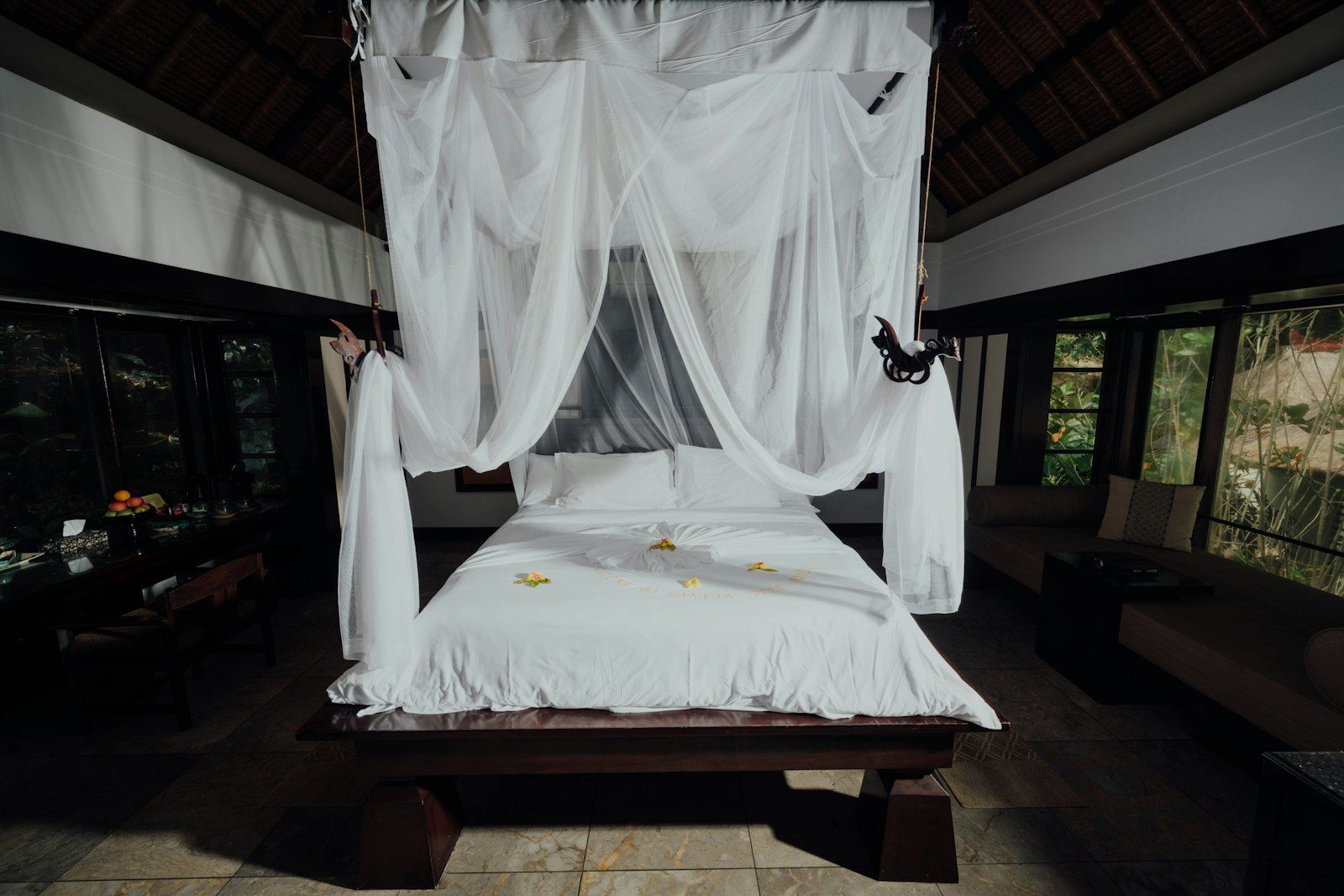
Bed nets are a second physical layer, and treated nets add an insecticidal effect. The NHS advises sleeping under mosquito nets treated with insecticide when avoiding malaria in affected parts of the world. Malaria is a serious infection spread by mosquitoes, and the NHS warns that a person can die from it if it is not diagnosed and treated quickly. It can take just one bite to get it. That is why the net advice sits alongside repellent and clothing rather than replacing them. A net must be hung so it fully covers the sleeping area and tucked or draped so no gap remains at the edges. An untreated net still blocks bites if it is intact, but the NHS specifically names insecticide-treated nets in its malaria guidance.
Covering babies, children and travellers
Some people cannot manage their own protection, so the barrier has to be built around them. The CDC says to cover strollers and baby carriers with mosquito netting for babies and children. That is a simple, practical instruction: the net becomes the child's portable screen. The NHS gives related advice for travel, telling people to wear long-sleeved clothing and trousers that cover arms and legs in the evening, when mosquitoes are most active. Clothing is itself a physical barrier, though thin or tight fabric can be penetrated. The NHS also advises getting travel health advice at least four to six weeks before a trip. That window allows time to plan nets, clothing and repellent before departure rather than improvising at the airport.
Water containers and the indoor check
Barriers fail if mosquitoes breed inside or beside the home. The CDC tells households to check for water-holding containers indoors and outdoors, and once a week to empty and scrub, turn over, cover, or throw out items that hold water. Its examples include tires, buckets, toys, pools, birdbaths, flowerpot saucers and trash containers. Scrubbing matters because eggs cling to container walls and survive simple emptying. Turning a container over removes the water entirely. Covering it denies access. Throwing it out removes the problem permanently. A weekly routine is easier to keep than a seasonal clear-out, and it fits ordinary household tasks. The same inspection can catch a damaged screen or a gap under a door, so one short walk around the home covers breeding sites and physical entry points together.
Repellent and barriers work as a set
Repellent is useful, but it is a topical product with a wear-off time, and it must be reapplied. The NHS advises using insect repellent on the skin that is 50% DEET-based to avoid malaria. That is accurate and worth stating plainly: DEET at the stated concentration is the product the NHS names. It is not a substitute for a net or a screen. Repellent protects exposed skin for a period, while a screen protects a whole room and a net protects a whole night of sleep. Barriers also protect people who should not or cannot apply repellent, including sleeping infants. Used together, the layers cover the gaps each one leaves. Used alone, each one depends on perfect human behaviour at the exact moment a mosquito arrives.
Why public health tracks the vectors
Physical barriers are local actions inside a wider surveillance system. The European Centre for Disease Prevention and Control states that vector borne diseases are a specific group of infectious diseases that are a re-emerging threat to Europe. It describes surveillance of the introduction, establishment and spread of the main disease vectors as one important aspect of preparedness. Through VectorNet, the agency maintains a database on the presence and distribution of vectors in Europe and regularly publishes updated distribution maps. It also highlights invasive mosquitoes colonising Europe as a topic. That context explains why screens and nets remain relevant in temperate countries, not only in tropical travel medicine. Risk changes with vector distribution, and household barriers are a practical response that any reader can apply without waiting for a new map.
Sources
- Preventing Mosquito Bites | Mosquitoes | CDC: US Centers for Disease Control and Prevention
- Disease vectors: European Centre for Disease Prevention and Control
- Malaria - NHS: National Health Service (England)
This article is general information, not medical advice. Ask a doctor or pharmacist about your own health.