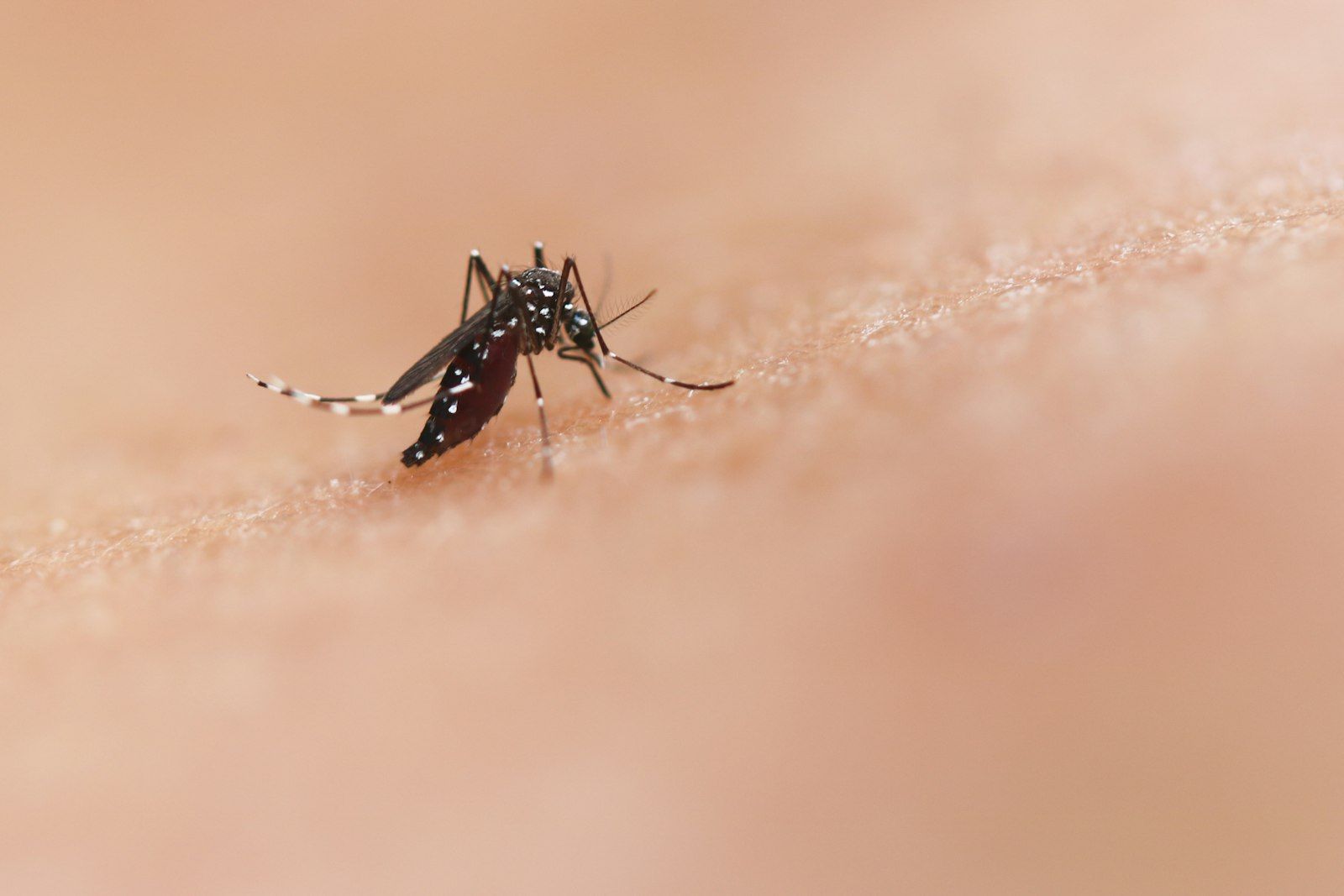
Two islands show how Aedes aegypti returns to Europe, why surveillance at ports and airports matters, and what the evidence does and does not say.
Why this mosquito matters again in Europe
Aedes aegypti is a small black and white mosquito that bites during the day. It is the main urban vector of yellow fever, dengue, chikungunya and Zika viruses, and it breeds in small containers of water close to people. The European Centre for Disease Prevention and Control reports that it once lived across all Mediterranean countries, the Caucasus, continental Portugal and the Atlantic archipelagos. It then vanished from Europe in the first half of the twentieth century. The last records were Spain up to 1953 and Portugal up to 1956. The Centre describes the reason for this disappearance as not well understood. Since then, the species has reappeared in parts of southern Russia and Georgia, and it has been introduced into the Netherlands, the Canary Islands and Cyprus.
What the current European map shows
The Centre publishes a distribution map at regional administrative level. Its update dated 3 June 2026 reflects the known situation in April 2026. In the European Union and European Economic Area, Aedes aegypti is known to be established in Cyprus and in the outermost regions of French Guiana, Guadeloupe, Martinique, Mayotte and Reunion, all part of France, and in Madeira, part of Portugal. Since the earlier update of June 2025, an introduction has been reported in Luxembourg. The map is produced jointly by the European Centre for Disease Prevention and Control and the European Food Safety Authority. It is offered to the public as a downloadable file in English. Luxembourg reported one introduction since June 2025, showing that importation events can happen far from the current established range.
The Cyprus record, from old notes to 2021
Cyprus has a long and interrupted record. Vasquez and colleagues, writing in the journal Parasite in 2023, note that Aedes aegypti was reported in Cyprus by Aziz in 1934 and last recorded by Foote and Cook in 1959. The species was detected again near the airport and port in Larnaka in late November 2021. Enhanced surveillance followed. Four BG traps and eight ovitraps ran in June and July 2022 and confirmed that the mosquito had survived the winter. Traps caught a female on 20 July 2022 and a male on 27 July 2022. Further captures came on 4 September 2022 in Meneou and Kiti, close to the same coastal area. The same paper reports that Aedes albopictus, another invasive mosquito, was caught in Limassol and Mesa Geitonia on 3 October 2022.
How Cyprus responded after detection
The response in Cyprus was structured. From September 2022, traps baited with dry ice and a lure covered the Larnaka and Limassol municipalities and wider areas. From October 2022, teams surveyed cells of 500 metres by 500 metres around each positive site, extending up to five kilometres away. An emergency action plan drafted in June 2022 was adopted by the Ministry of Health in September 2022. A contingency plan proposed in December 2022 was adopted in April 2023. Measures include door-to-door work, removal of breeding sites, larval treatment, outdoor adulticide spraying, a public information campaign and a sterile insect technique component. Traps also caught Aedes albopictus in Limassol and Mesa Geitonia on 3 October 2022.
Madeira, dengue and the 2025 finding
Aedes aegypti was first detected on Madeira in 2005. Zé-Zé and colleagues, writing in Parasites and Vectors in 2026, describe a dengue outbreak on the island that ran from 23 September 2012 to 3 March 2013, with 1080 confirmed cases. The Centre reports that the same 2012 outbreak had produced more than 2200 cases by early January 2013, plus 78 among European travellers returning from the island. Densities later fell, likely because of community-based vector control, and only imported cases were found for years. Then, on 8 January 2025, two related women aged 17 and 52 from one Funchal household attended a private clinic with dengue-compatible symptoms. Neither had travelled outside Madeira. Zé-Zé and colleagues report that the 2012 Madeira outbreak produced 1080 confirmed cases before ending on 3 March 2013.
What the Madeira investigation found
Investigators placed 17 traps within 250 to 500 metres of the residence, alongside a routine network of 32 traps and 177 ovitraps. Collections ran from 10 January to 31 March 2025. In total, 393 Aedes aegypti were screened in 80 pools. One pool of nine adults, collected near the residence between 13 and 24 January, tested positive for dengue virus serotype 2, lineage 2II_F.1.1.3. The same virus was confirmed retrospectively in one clinical case. No further positive pools were found, which suggests limited or no onward transmission. The finding came during low mosquito abundance and low climatic suitability, pointing to possible off-season introduction where populations persist all year. The authors describe the lineage as dengue virus serotype 2, lineage 2II_F.1.1.3.
What this means for public health
The authors of the Madeira study state that local transmission there can occur all year. The authors cite climate scenarios projecting a rise of up to 3.7 degrees Celsius. The Centre notes that Aedes aegypti is limited by intolerance of temperate winters and by high egg mortality in frost, but sees no reason why it should not become re-established widely across the Mediterranean. Dispersal by ferry from Madeira is still considered the greatest risk of introduction into Europe. The Cyprus authors call for cooperation between countries to improve detection at points of entry and warn that uncontrolled vectors on islands can maintain a permanent virus reservoir. Practical protection rests on removing standing water, using screens and repellents correctly, and reporting mosquito bites to local health services.
Sources
- Aedes aegypti - Factsheet for experts: European Centre for Disease Prevention and Control
- Aedes aegypti - current known distribution: April 2026: European Centre for Disease Prevention and Control
- Two invasions at once: update on the introduction of the invasive species Aedes aegypti and Aedes albopictus in Cyprus - a call for action in Europe: Parasite, via PubMed Central
- Detection of dengue virus serotype 2 in local Aedes aegypti populations, Madeira Island, Portugal, 2025: Parasites and Vectors, via PubMed Central