ECDC now sorts every area in Europe into one of four risk levels for locally-acquired dengue, chikungunya and Zika. The framework is written for public health authorities, but it maps cleanly onto a household question: how much protection do I actually need where I live right now? Here is the honest translation, level by level, with no fear and no gadget upsell.
Europe's mosquito risk is no longer one number. The risk of catching dengue, chikungunya or Zika from a mosquito bite in Lisbon is not the risk in Munich, and neither is the risk in a town on the French Mediterranean coast where a cluster of local cases was confirmed last summer. For years that variation was left implicit. In July 2025 it was written down.
The European Centre for Disease Prevention and Control (ECDC) published Public health guidance for assessing and mitigating the risk of locally-acquired Aedes-borne viral diseases in the EU/EEA. Instead of a single blurred warning that "mosquitoes are spreading north," ECDC now sorts every area in the EU/EEA into one of four risk levels for locally-acquired Aedes-borne viral diseases: dengue, chikungunya and Zika.
The guidance is written for public health authorities, laboratories and emergency planners. It is a professional toolkit, not a shopping list, and ECDC does not recommend any product or brand. But the framework answers the first question honestly, and it is a question every household in southern and central Europe is now entitled to ask: where, on the risk map, am I, and how much protection does that actually justify?
This page is Mosticare's plain-language translation of the ECDC levels, and an honest account of what each level means for the way you sleep, sit outside, and travel. The framework is ECDC's. The level-to-protection mapping is ours, grounded in World Health Organization personal-protection principles rather than in fear, and we will be clear about which is which.
Why ECDC built a tiered system at all
Two mosquitoes drive this. Aedes albopictus, the Asian tiger mosquito, can transmit dengue, chikungunya and Zika. Aedes aegypti, the yellow fever mosquito, can transmit the same viruses and yellow fever. Both are invasive in Europe, and both are day-biting, which matters later when we talk about protection.
ECDC's guidance records that Aedes albopictus has been reported in 13 countries in the European Union, and that Aedes aegypti has been detected in parts of the EU including Cyprus, the Canary Islands (Spain) and Madeira (Portugal). Warmer, longer summers extend the window in which these mosquitoes can breed and in which a virus can complete its cycle inside them. At the same time, international travel keeps importing the viruses in the blood of returning travellers, and ECDC notes that between 2021 and 2024 the number of autochthonous (locally-acquired, not travel-imported) dengue outbreaks in the EU/EEA rose considerably.
The pattern is consistent: an infected traveller returns from an endemic region, a locally established mosquito population bites them, and a short local transmission chain begins. A single continent-wide alarm is useless against that pattern, because the risk in a Portuguese coastal town and a Finnish suburb are not remotely the same. ECDC's four levels exist to match the response to the reality of a specific place at a specific point in the season.
The four levels, in plain language
ECDC's levels are defined by three things: whether the mosquito vector is established, the area's receptivity and vulnerability, and whether local transmission is happening this season. Two of those terms are worth learning, because they do the heavy lifting:
- Receptivity is how suitable the area is for transmission: the presence and density of Aedes mosquitoes plus the ecological and climatic conditions that favour the virus.
- Vulnerability is how likely the virus is to arrive and spread undetected: the influx of infected travellers and the health system's capacity to catch and contain infections quickly.
The emphasis shifts as you climb. At Levels 1 and 2 the focus is on surveillance and prevention; at Levels 3 and 4 it moves to response and control.
Level 1, no established vector
What it means: the Aedes vectors of dengue, chikungunya and Zika are not established in the area. There is no local mosquito capable of sustaining transmission.
What a household needs: general awareness, nothing more. This is the honest part of the message that panic marketing skips. If you live in a Level 1 area, you do not need a treated net for local mosquitoes, because the relevant mosquito is not there. The only live consideration is travel: if you are heading to a higher-level region, your protection should match your destination, not your home.
Level 2, vector established, no transmission this season
What it means: the mosquito is established and over-wintering locally, but no local transmission of the virus has been detected this season. ECDC splits this into two sub-levels:
- Level 2a, low receptivity and/or vulnerability (established vectors but low density, unfavourable climate, few travellers arriving from higher-risk areas).
- Level 2b, medium to high receptivity and vulnerability. Areas with a history of sporadic local transmission in previous years also sit here.
What a household needs: this is where a physical barrier becomes a sensible, proportionate precaution rather than a necessity. The vector is present; the virus is not circulating locally today. A zero-chemical approach fits the risk exactly, and it puts nothing on skin and nothing into the air:
- Remove standing water. Aedes breeds in tiny volumes: saucers under plant pots, blocked gutters, buckets, uncovered water butts. Emptying them weekly is the single most effective thing an individual can do, and it costs nothing.
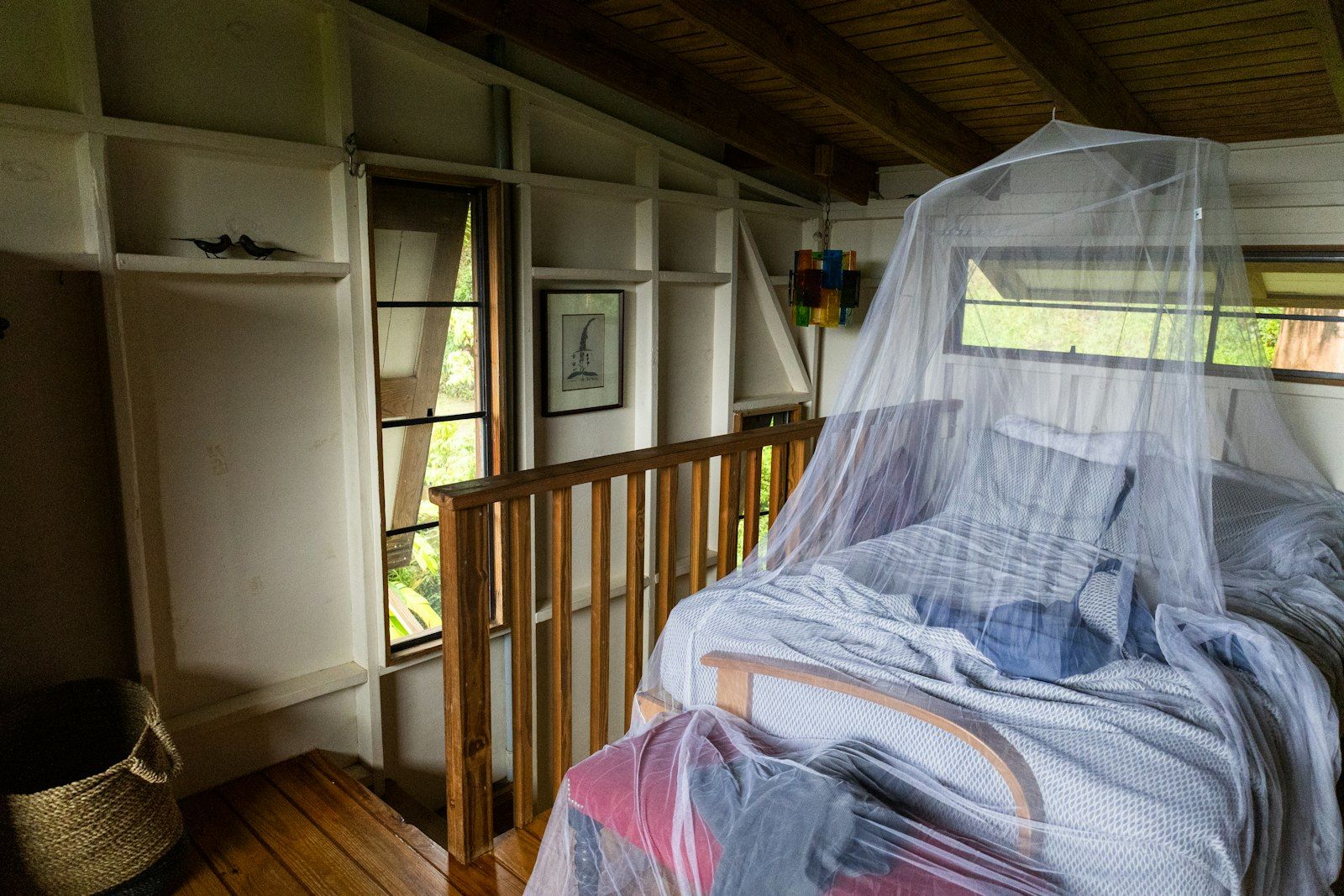
- Add physical barriers. Outdoor living space is where the tiger mosquito bites, because Aedes albopictus is a daytime biter that favours shaded gardens, terraces and balconies. A zero-chemical outdoor barrier, the kind our Terrazza outdoor range (the TE-UNO-U and TE-DUE-U gazebos) is built for, lets you keep using the space without dosing the air you and your family breathe. Bedrooms benefit from an untreated canopy or bed net as a simple, permanent barrier, especially in ground-floor rooms and where windows are opened at night for airflow during a heatwave.
At Level 2 an untreated physical barrier is usually enough, because there is no local virus to intercept. A repellent such as DEET or picaridin is a reasonable supplement for exposed skin when you are out and about; it is a genuine tool, but it is a top-up, not a barrier, and it does not replace one.
Level 3, local transmission confirmed this season
What it means: the area has at least one confirmed autochthonous case of an Aedes-borne virus this season. ECDC again uses two sub-levels: Level 3a where the number of cases and clusters is low and the transmission chains are still traceable, and Level 3b where the number is high enough to overwhelm tracing capacity. This is the point where the guidance's emphasis moves from prevention to active response and control: authorities step up surveillance, vector management and public communication.
What a household needs: protection stops being optional, and the sensible posture is to combine measures rather than lean on one. Keep the Level 2 barrier basics in place, use skin repellent when outdoors at the times your local authority flags, and follow regional advisories closely, because during an active cluster they may add targeted measures.
This is also the context in which a permethrin-treated net earns its place as the sleeping barrier. A treated net does two jobs an untreated one cannot: it blocks contact, and the permethrin on the mesh deters and knocks down mosquitoes that land on it. The certification is what separates a real product from marketplace filler. Mosticare's treated nets are built to WHO standards and, for sale in the EU, authorised under the EU Biocidal Products Regulation (BPR). A generic "insect-repellent net" with no such standard behind it is a claim, not a protection. This is a different product from the untreated Terrazza and canopy lines, doing different work, and the biocidal standards that apply to treated nets do not apply to the untreated range.
Level 4, sustained, self-supporting transmission
What it means: the highest tier. ECDC defines Level 4 as endemo-epidemic, where local transmission no longer depends on importation of the virus from elsewhere. In practice no EU/EEA area currently sits at Level 4 for these viruses; it describes the endemic situation found in parts of the tropics and sub-tropics, and it is the level a European traveller should have in mind when visiting those regions.
What a household needs: where transmission is self-sustaining, treat certified protection as primary, not precautionary. A permethrin-treated net for sleep, an outdoor barrier in use, and disciplined removal of standing water. For Europeans this is chiefly a travel scenario: protect yourself to the standard of the region you are visiting, not the standard of home, and consult ECDC travel guidance and the destination's national health authority before you go. During any active outbreak, the specific current instruction from the responsible authority overrides general advice, including this page.
What this framework does not license
The ECDC levels are a reason for proportion, not panic. Some honest caveats:
- A level describes an area, not a person. Being in a Level 3 area does not mean you are infected, and being in a Level 1 area does not mean you are immune to anything you might pick up travelling.
- Levels change within a season. ECDC builds in triggers for re-assessment precisely because an area can move up when a cluster appears and down when the season ends. Check the current level, not last year's.
- Chikungunya and dengue are serious and often disabling, but rarely fatal. The right response is a good barrier and sound information, not fear.
- Repellents work, as a supplement. DEET and picaridin are effective on skin for a window of hours. They are not a substitute for a physical barrier over a whole night, and anyone selling them as one is overselling.
- An outbreak is exactly when unproven gadgets sell hardest. Ultrasonic buzzers, wristbands and citronella candles surge in a scare. A physical barrier and a correctly certified treated net are the tools with evidence behind them; most of the rest is noise sold against your worry.
- We sell barriers, so read us with that in mind. Mosticare makes mosquito nets and outdoor structures. That is exactly why we tie every recommendation to a published standard, ECDC's framework and WHO's protection principles, rather than to our own say-so. If a measure is not proportionate to your level, we would rather you did not buy it.
Find your level, then match the layer
The practical workflow is simple:
- Check your area's current level. ECDC's weekly Communicable Disease Threats Report and its dengue and chikungunya surveillance pages track where local transmission stands through the season, and your national health authority (for example Santé publique France, Istituto Superiore di Sanità, or the relevant body in your country) confirms local clusters first.
- Match the protection layer to the level, using the table below.
- Re-check across the season. An area can move up a level as the summer progresses; ECDC's framework is explicitly built to be re-assessed.
The four levels are ECDC's. The product mapping is ours, and it is deliberately conservative: at low levels we tell you a barrier is a precaution or not needed at all, and we only escalate to a treated net when a virus is genuinely circulating where you sleep. That is the honest shape of mosquito risk in Europe, and the reason a single scare-and-sell message was never going to be good enough.
Medical disclaimer
This page is general public-health information, not medical advice. It does not replace guidance from ECDC, the WHO, or your national or local health authority, and it is not a substitute for consulting a qualified healthcare professional about your individual circumstances, travel plans, or symptoms. If you develop fever, rash, joint pain or other symptoms after mosquito exposure or travel, seek medical care and mention where you have been. Risk classifications change during and between seasons; always confirm the current status of your area with an official source before acting.
Primary source: ECDC public health guidance on locally-acquired Aedes-borne viral diseases in the EU/EEA (published 1 July 2025). The four risk levels and their definitions are ECDC's; the level-to-protection mapping is Mosticare Editorial's interpretation, grounded in WHO personal-protection principles. Byline: Mosticare Editorial. Corrections: corrections@mosticare.org.