West Nile virus (WNV) is the mosquito-borne disease that asks the narrowest question of a household in Italy, Greece, Romania, Bulgaria or Croatia between July and September: can a Culex mosquito reach the bedroom between dusk and dawn. The protection answer is structural (a net over the bed, a screen on the window, source reduction around the house), not pharmaceutical.
Of the mosquito-borne diseases that recur across Southern and Southeast Europe every summer, West Nile virus (WNV) is the one that asks the narrowest question of an individual household: can a mosquito get into the bedroom between dusk and dawn? That question is narrow because the answer is structural, not pharmaceutical. It is solved by a net over the bed, a screen on the window, and the understanding that the vector doing the biting is not the day-biting Aedes albopictus the press talks about in July - it is a dusk-active Culex, and it has a different timetable.
This explainer is written as evergreen disease education for households in Italy, Greece, Romania, Bulgaria and Croatia - the five EU/EEA Member States in southern and south-eastern Europe where West Nile virus is a recurring seasonal concern. ECDC describes WNV infection as endemo-epidemic in Europe, present in southern, eastern and western European countries, and records cases and outbreaks across the region since the first major European epidemic in Romania in 1996. The same biology, the same household risk windows and the same physical-barrier protection apply across all five markets. The local differences sit in surveillance infrastructure, reporting timelines, and the precise way each national authority publishes its weekly figures.
What West Nile virus is - and what it is not
West Nile virus is a flavivirus maintained in a bird-mosquito-bird transmission cycle. Culex mosquitoes - chiefly Cx. pipiens in continental Europe and its sibling Cx. molestus in urban environments - pick up the virus when they feed on infected birds, and pass it on when they subsequently feed on humans, horses and other incidental hosts. Humans and horses are dead-end hosts: they do not sustain transmission. The disease is not contagious person-to-person, and is not food-borne or water-borne.
What WNV is not:
- Not a tropical disease. It is established endemically across Southern and Southeast Europe. ECDC records the first major European WNV epidemic in Romania in 1996, when about 400 cases were identified. Southern France and Northern Italy followed in the early 2000s, and Greece had its first large outbreak in 2010. Cases and outbreaks have been reported across southern, eastern and western Europe since the Romanian epidemic (ECDC).
- Not dengue, not chikungunya. Those two are Aedes albopictus viruses - day-biting, container-breeding, with different geography and different protection patterns. Mixing them up is one of the more common errors in European consumer press. The protection logic for Aedes-borne viruses (daytime terrace and garden) and Culex-borne WNV (night-time bedroom) is different.
- Not preventable by vaccines available to the public. There is no human vaccine against WNV licensed for the general European population. Equine vaccines exist and are used in horses; that is a separate programme run by national veterinary authorities. The protection layer for people sits in the household, not in the clinic.
The vector: Culex pipiens and the dusk-to-dawn biting window
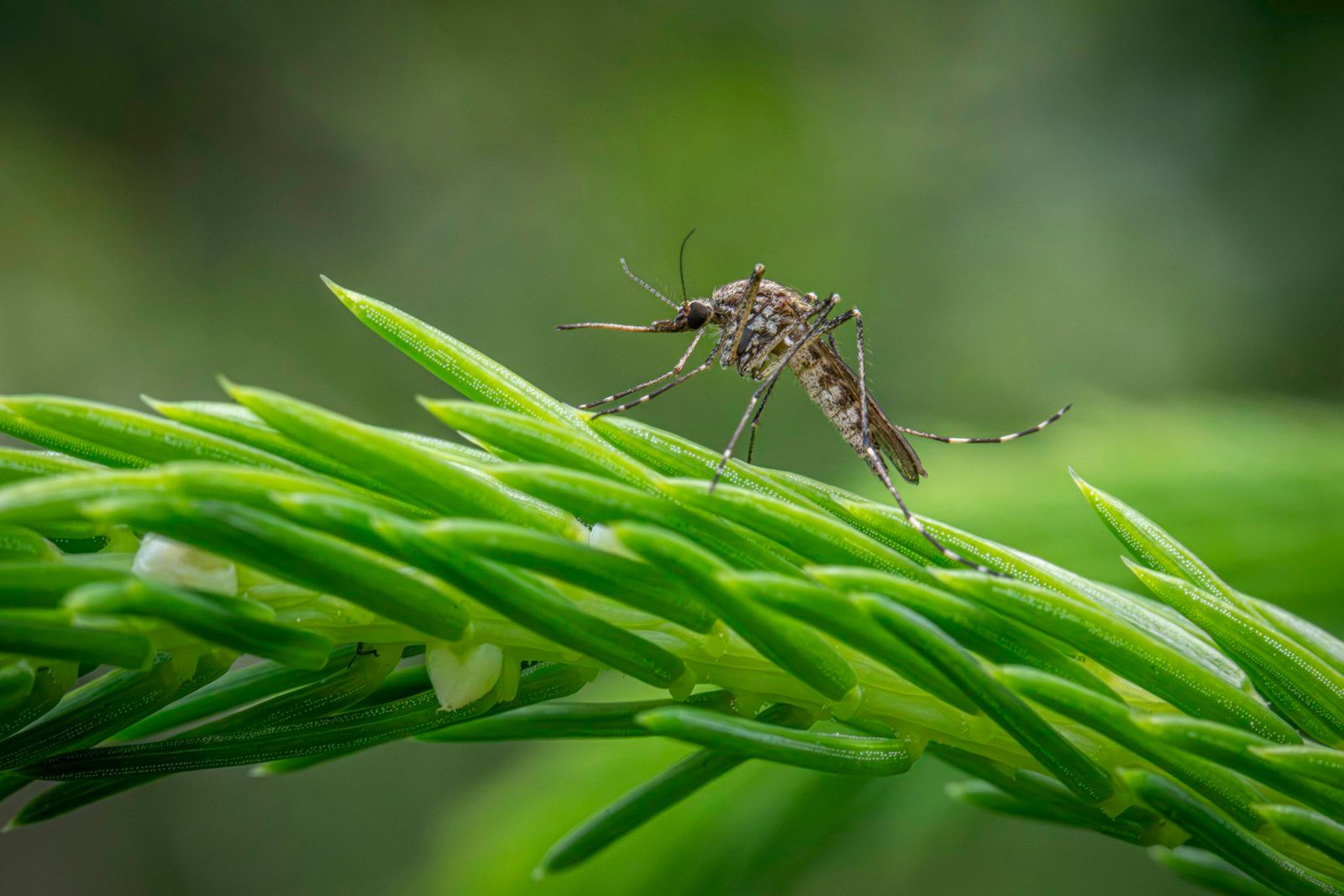
The species doing the work in continental Europe is Culex pipiens, the common house mosquito. It is small, brown, unremarkable, and - unlike Aedes albopictus - it is nocturnal. Females bite warm-blooded hosts at night, indoors or outdoors, and rest indoors after feeding (ECDC). The same species will rest during the day in shaded vegetation, cellars, sheds, and the cooler corners of inhabited buildings.
Three behavioural facts about Cx. pipiens drive the household protection logic:
- It is a dusk and night feeder. This is the critical distinction from Ae. albopictus. An open bedroom window at 22:00 in August in Pavia, Tessalonica, Bucharest, Plovdiv or Slavonski Brod is an open invitation.
- It breeds in standing water that is not container-sized. Where Ae. albopictus uses small container water (a flowerpot saucer, a bottle cap), Cx. pipiens uses larger accumulations - blocked drains, flooded cellars, irrigation overflow, neglected ponds, used tyres laid flat, and any organically rich standing water in urban and peri-urban settings. Source reduction works on Culex but looks different from Aedes source reduction.
- It enters the house. Unlike Ae. albopictus, which tends to feed outdoors, Cx. pipiens readily enters bedrooms through open windows, doors left ajar for ventilation in summer, and unsealed gaps around window frames. Indoor biting is the rule, not the exception, for WNV-relevant transmission.
The corollary: if your country is one of the five SE EU Member States with documented WNV transmission, the protection question for July through September is not "what do I put on my skin during the day" - it is "what is between me and a Culex mosquito between dusk and dawn."
The countries where this matters
Italy, Greece, Romania, Bulgaria and Croatia all reported locally acquired West Nile virus cases to ECDC in 2025, and each has recorded cases across multiple seasons. The precise affected provinces change year to year. The general geography does not.
Italy
Northern Italy - the Po Valley in particular - has been the most consistently affected region of the EU since the early 2000s. The provinces of Pavia, Lodi, Cremona, Mantua, Modena, Ferrara, Bologna, Parma, Piacenza and Rovigo recur in almost every annual WNV season. Central Italy (Tuscany, parts of Lazio) and the areas around Naples and Caserta report cases in some years. The Italian national reference is the Istituto Superiore di Sanità (ISS) and the integrated human-veterinary-entomological surveillance run by the regional health authorities.
For an Italian household outside the affected provinces the risk is low but not zero - seasonal workers, agricultural contractors and second-home owners returning to rural properties in July and August have been diagnosed in years of high circulation.
Greece
Greece had its first major WNV outbreak in 2010 in Central Macedonia, and has had confirmed locally acquired human cases every year since. The recurrently affected regions are Central Macedonia (especially the regional units of Thessaloniki, Pella, Imathia, Kilkis and Serres), East Macedonia and Thrace, and Western Greece. The 2018 outbreak, centred on the Athens metropolitan area, was the largest ever recorded in Greece, with more than 300 locally acquired cases and over 50 deaths - a clear reminder that urban and peri-urban transmission is possible in Greek conditions, not just rural. The Hellenic National Public Health Organization (EODY) publishes weekly West Nile virus surveillance bulletins during the transmission season.
For a Greek household, West Nile virus is a seasonal risk through the warm months. Mosquito control around the home - particularly Cx. pipiens breeding sites in peri-urban and rural settings - is coordinated regionally.
Romania
Romania has been a consistent WNV reporting country since the 1996 outbreak that was, at the time, the largest recorded in Europe. The recurrently affected counties are in the south and southeast - Dolj, Olt, Teleorman, Giurgiu, Ilfov, Ialomița, Călărași, Brăila, Galați, Tulcea and Constanța - the Danube floodplain and the Black Sea coast. Bucharest and its metropolitan area have been recurrently affected in high-circulation years. The National Institute of Public Health (INSP) and the National Centre for Communicable Diseases Surveillance and Control run the integrated surveillance. Romania also has the largest equine WNV burden of any EU Member State in some years, with sporadic horse deaths functioning as an early sentinel.
For a Romanian household, the relevant window runs from July to early October, with peak risk in August.
Bulgaria
Bulgaria reported its first confirmed locally acquired human cases in 2018 and has had recurrent transmission since, mainly in the northeastern and central-southern regions. Plovdiv, Pazardzhik, Blagoevgrad, Stara Zagora, Haskovo, Kardzhali, Yambol, Sliven, Burgas, Varna, Shumen, Dobrich and Silistra have all been in the case map at some point. The Bulgarian Ministry of Health and the National Centre of Infectious and Parasitic Diseases (NCIPD) coordinate the integrated surveillance. Bulgaria is also an important country on the bird-migration corridor between sub-Saharan wintering grounds and northern European breeding grounds - a structural driver of when and where WNV shows up.
For a Bulgarian household, the season runs roughly from early July through September.
Croatia
Croatia has had recurrent WNV cases in the eastern counties - Osijek-Baranja, Vukovar-Syrmia, Virovitica-Podravina, Požega-Slavonia, Brod-Posavina, Sisak-Moslavina - with sporadic detections elsewhere along the Drava and Sava river corridors. The Croatian Institute of Public Health (HZJZ) coordinates the integrated surveillance with veterinary and entomological partners. Croatia's WNV season is shorter and lower-intensity than Italy or Romania but the underlying Culex vector ecology is the same.
Symptom spectrum and when to call a doctor
About 80% of human WNV infections are asymptomatic (WHO; ECDC). Of the remaining 20%, the great majority present as a self-limiting febrile illness - West Nile fever - with fever, headache, muscle aches, fatigue and sometimes a maculopapular rash. WHO puts the incubation period at usually 3 to 14 days, and ECDC describes West Nile fever as often a mild, self-limiting illness from which patients recover within a week.
Less than 1% of infected individuals develop neuroinvasive disease - West Nile neuroinvasive disease (WNND) - which presents as meningitis, encephalitis or acute flaccid paralysis (ECDC). Older adults (over 50) and people with immunosuppression are at higher risk of severe outcomes (WHO). So are people with chronic conditions such as diabetes, hypertension and kidney disease (ECDC). ECDC puts the case-fatality ratio among WNND patients at up to 17%, with a higher long-term neurological and functional burden among survivors.
There is no specific antiviral treatment for WNV. Clinical management is supportive. The clinical decision point is therefore early recognition - particularly in older or immunocompromised household members developing high fever, neck stiffness, confusion, weakness or seizures within the typical transmission season - and prompt presentation to emergency services.
The protection layer that exists in your house tonight
The protection layer for WNV in a SE EU household is built from four components. None of them is new. All of them are physical, none relies on a new chemical exposure.
- A mosquito net over the bed. For sleeping adults and children in the WNV transmission season, an untreated mosquito net draped over the bed is the single most reliable chemical-free barrier to Culex bites. Properly tucked under the mattress or with a framed canopy, the net eliminates indoor-biting exposure for the hours when Cx. pipiens is most active.
- Screens on bedroom windows and doors. Tight-fitting insect screens on the bedroom windows and on any door left open for cross-ventilation in summer prevent Culex from entering the room in the first place.
- Elimination of Culex breeding sites in the immediate vicinity. This is different from Aedes source reduction. Cx. pipiens uses larger and more organically rich standing water: blocked roof gutters, neglected ponds, water-filled containers that have been in place for weeks, used tyres stored flat, flooded cellars, and any standing water that has been undisturbed for ten days or more. A weekly walk around the house and garden to drain, dry or treat these accumulations reduces the local biting pressure.
- Personal protection during outdoor evening hours. Where presence on the terrace, in the garden, or at an outdoor event during the dusk-to-dawn window is unavoidable, personal protection - long sleeves, long trousers, light-coloured clothing, and an age-appropriate skin repellent applied according to label - is the third line of defence. The first line is the bedroom net; this is the supplementary one.
What the protection layer is not: it is not a prescription, not a vaccination, not a chemical indoor treatment. The chemical layer (residual indoor spraying, outdoor ultra-low-volume adulticiding, larviciding of standing water with Bacillus thuringiensis israelensis or insect growth regulators) is a public-health tool used by municipal vector control. It complements, but does not replace, the household physical-barrier layer.
Why bedroom nets - and the regulatory frame around them
For households in the SE EU transmission zone, the relevant barrier products sit in two regulatory families.
Untreated nets - the polyester or cotton mosquito nets, framed canopies and gazebo nets used over beds and around outdoor seating - are general textile products. They make no chemical claims. They carry no biocidal-product registration. They are the simplest, longest-lasting and most easily maintained part of the household barrier. They are what a family with a baby, a toddler, an elderly relative or an allergic individual can deploy tonight.
Treated nets - insecticide-treated nets (ITNs) - are a different product family. They carry a permethrin or other pyrethroid treatment and fall under the European Biocidal Products Regulation (BPR, Regulation (EU) No 528/2012). WHO prequalifies insecticide-treated vector-control products, including insecticide-treated nets, after assessing that they are safe, effective and manufactured to a high-quality standard. Untreated bed canopies, gazebo nets and baby or crib canopies carry no insecticide. They are not WHO-prequalified products, are not BPR-registered biocidal products, and make no such claim.
For households in the SE EU WNV zone, untreated nets over the bed, plus screened windows, plus source reduction around the house, are the complete physical-barrier layer. Where a household has a specific need for additional protection - immunocompromised family members, very elderly relatives, prior history of severe mosquito-borne illness - the conversation about treated products is one to have with the treating physician and with reference to the locally labelled BPR-registered products.
How to use this explainer
This article is written as evergreen education. It does not depend on the case count of any single year. The country sections are stable in their geography and in their seasonal windows, even when the precise affected province list shifts between seasons. The four-part household protection layer is independent of the headline case numbers.
For the live weekly figures, the right place to look is the ECDC West Nile virus weekly monitoring for the EU/EEA aggregate, and the national reference (ISS for Italy, EODY for Greece, INSP for Romania, NCIPD for Bulgaria, HZJZ for Croatia) for country-specific case counts and affected-area updates. These are the agencies whose surveillance defines what is known at any given moment.
The structural facts do not change: Culex pipiens bites at dusk and through the night. WNV transmits through that bite. An untreated net over the bed breaks the chain. A screened window keeps the mosquito out in the first place. Source reduction around the house lowers the local biting pressure. These four moves, deployed every summer in the SE EU WNV window, are what every household in the affected region has under its own control.
Sources
- European Centre for Disease Prevention and Control. West Nile virus infection - annual epidemiological reports and weekly monitoring updates. Continuously updated.
- European Centre for Disease Prevention and Control. Factsheet about West Nile virus for the general public.
- European Centre for Disease Prevention and Control. Culex pipiens, factsheet for experts. Females bite warm-blooded hosts at night, indoors or outdoors.
- Istituto Superiore di Sanità (ISS), Italy. Sorveglianza integrata del West Nile virus - rapporti annuali.
- Hellenic National Public Health Organization (EODY). Weekly West Nile virus epidemiological surveillance reports.
- National Institute of Public Health, Romania (INSP). West Nile virus surveillance updates.
- National Centre of Infectious and Parasitic Diseases, Bulgaria (NCIPD). WNV surveillance bulletins.
- Croatian Institute of Public Health (HZJZ). West Nile virus - annual reports.
- World Health Organization. West Nile virus - fact sheet. Continuously updated.
- World Health Organization. Guidelines for malaria (for the framework on insecticide-treated nets in endemic settings; not applicable to untreated household products in Europe).
- European Commission. Regulation (EU) No 528/2012 concerning the making available on the market and use of biocidal products (BPR).
- European Centre for Disease Prevention and Control. Historical data on local transmission in Europe for West Nile virus.
- World Health Organization. Prequalification of vector control products.
This article is general information, not medical advice. Ask a doctor or pharmacist about your own health.