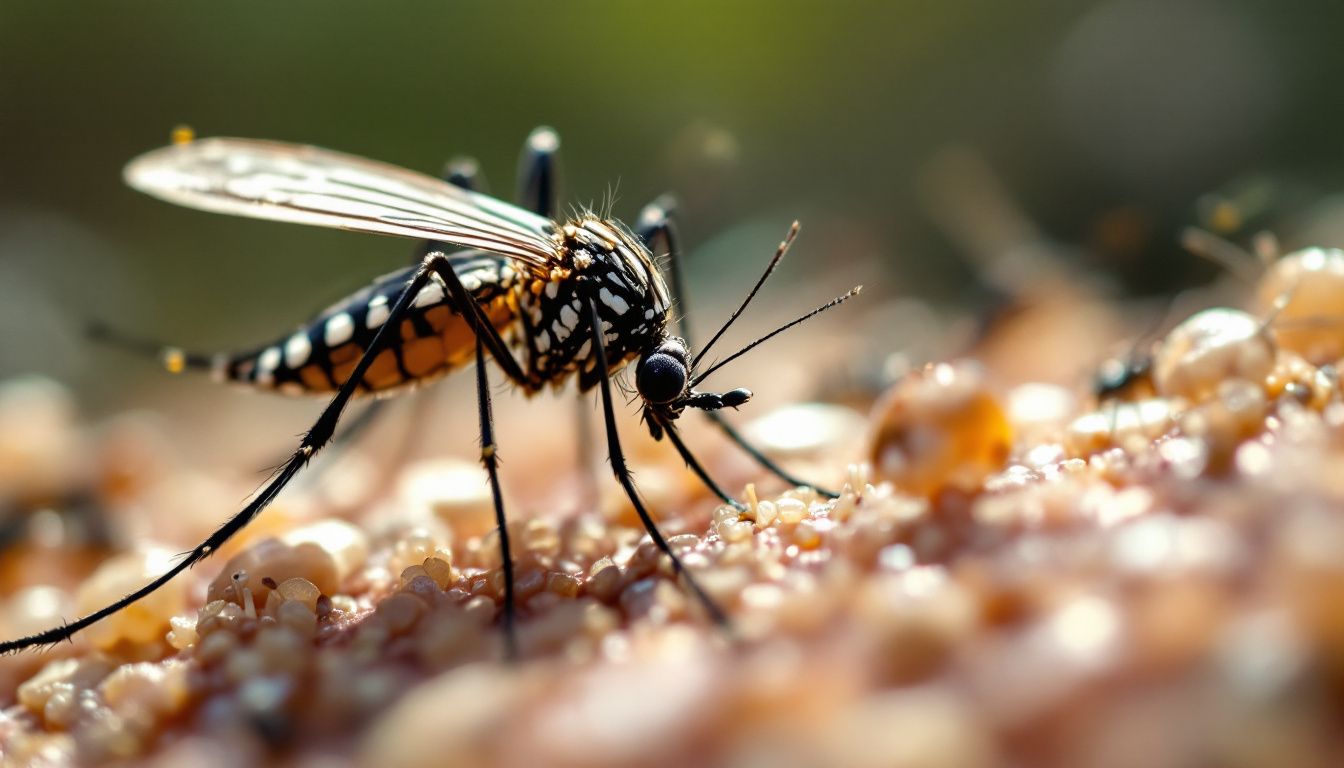
A systematic review of 27 studies and the first nationwide survey of 44,490 French blood donors together show West Nile virus is shifting from sporadic outbreaks to an established European presence. Integrated surveillance and blood-donor screening are emerging as the front-line response to a climate-driven spread.
Two papers published across the first ten days of July 2026 just closed the institutional question on West Nile virus endemic progression in continental Europe. The first is a systematic review of 27 studies that maps the autochthonous WNV endemic progression across Europe and identifies the four pillars of the institutional response. The second is the first nationwide French mainland blood-donor seroprevalence baseline that documents silent multi-year exposure in two regions before the first autochthonous human cases were identified. The two papers share the structural recognition that integrated surveillance, blood donor screening, and improved serological discrimination are the response to climate-driven WNV endemic progression, and that the consumer-protection layer is the in-season complement to the institutional recognition that the household-level human-vector interface requires.
What Heinrich et al. actually mapped
Heinrich PD, Bereswill S, Heimesaat MM at the Charité - University Medicine Berlin Gastrointestinal Microbiology Research Group within the Institute of Microbiology, Infectious Diseases and Immunology published a systematic review of autochthonous West Nile virus infections in Europe in the European Journal of Microbiology and Immunology on 7 July 2026 (DOI 10.1556/1886.2026.00010, PMID 41842950). The review covers 27 included studies published since 2015 on autochthonous human WNV infections in Europe and synthesises the institutional evidence on the endemic progression question.
The four pillars of the editorial platform emerge directly from the review. The first is progressive geographic expansion across Italy, France, Germany, the Balkans, and the Mediterranean basin, with new NUTS-3 regions surfacing autochthonous transmission on a year-on-year basis. The second is rising temperatures as the most consistent meteorological correlate of WNV amplification, with seasonal transmission windows extending earlier into the calendar year and later into autumn. The third is integrated surveillance across mosquito pools, avian hosts, and human cases, with each layer contributing an independent signal that the institutional response must reconcile into a single operational picture. The fourth is blood donor screening paired with improved serological discrimination, with the screening layer catching silent exposure that the human-case surveillance system would otherwise miss by years.
The authors' conclusion is the institutional line that matters: the WNV endemic progression in Europe is structurally established, and the institutional response must build on integrated surveillance, blood donor screening, and improved serological discrimination as the three operational layers that the academic evidence supports. The structural finding the paper delivers is unambiguous: WNV endemic progression is a structural European reality, and the institutional recognition of that reality is now in the peer-reviewed canon.
What Jourdan et al. actually measured
Jourdan P, Barthélémy K, Brisbarre N, Isnard C, Gallian P, Priet S, de Lamballerie X and colleagues at the Etablissement français du sang, the Aix-Marseille Université Unité des Virus Émergents consortium (Aix-Marseille Université, Università di Corsica, Institut de Recherche pour le Développement, Institut de Recherche Biomédicale des Armées), and Santé publique France published the first nationwide French mainland blood-donor West Nile virus seroprevalence study in Eurosurveillance on 3 July 2026 (DOI 10.2807/1560-7917.ES.2026.31.26.2500808, PMID 42394633). The team screened 44,490 volunteer blood-donor sera collected in 2021 and 2022 for anti-WNV IgG by ELISA on pools of up to four samples, then tested non-negative pools individually. Virus neutralisation tests were used to resolve non-negative results against cross-reactive flaviviruses.
The headline finding is that seroprevalence was low but real: 0.87 percent at the pool level and 0.97 percent individually. Prevalence in Nouvelle-Aquitaine was 1.13 percent and in Ile-de-France was 1.81 percent, both of which recorded their first autochthonous human cases in 2023 and 2025 respectively. Living in the south of France (Occitanie, Provence-Alpes-Côte d'Azur, Corsica) and ABO blood group were the identified risk factors. The print-issue-indexed publication on 3 July 2026 is the institutional signal that the French mainland seroprevalence baseline has been formally adopted into the European surveillance canon.
The authors' conclusion is the surveillance line that matters: seroprevalence of West Nile virus in France is low but variable, suggesting that WNV may have circulated undetected in some areas, and monitoring flavivirus prevalence in blood donors can serve as an early warning system for human infections and provide valuable data for public health preparedness.
The structural finding the paper delivers is that the relevant unit of WNV surveillance is not the human case. It is the blood-donor pool, which catches silent multi-year exposure years before the human-case surveillance system registers the first autochthonous transmission event. The autochthonous-transmission window for France hexagonale opened years before the surveillance system caught it, and the blood-donor screening layer is the institutional mechanism that compresses the recognition lag from years to weeks for the next region that crosses the endemic threshold.
Why the four-pillar peg matters for the 2026 cycle
The two papers together are the institutional peg that climate-driven WNV endemic progression in continental Europe has been structurally established, and that the institutional response must build on the four pillars of progressive geographic expansion awareness, climate-driver recognition, integrated surveillance across mosquito pools, birds, and humans, and blood donor screening paired with improved serological discrimination. The Heinrich review establishes the 4-pillar editorial platform at the systematic-review level, and the Jourdan paper demonstrates pillar four in operation at the 44,490-sera French mainland scale.
The 2026 surveillance frame holds the structural reading for this peg. The ECDC Week 27 West Nile virus weekly report (data 1 July 2026, produced 2 July 2026) carries the W27 cumulative platform of 6 cases across 3 countries (Italy 3, Romania 2, North Macedonia 1) and remains the freshest weekly reading as of the 10 July 2026 cycle. The Santé publique France national reinforced arboviroses bulletin of 8 July 2026 (surveillance period through 5 July 2026) confirms zero autochthonous chikungunya, dengue, Zika, and West Nile virus cases in France hexagonale alongside 65 imported chikungunya cases (up from 62 last week), 206 imported dengue cases (up from 189 last week), and 8 imported Zika cases year-to-date since 1 May 2026. The 0-autochthonous-WNV reading in metropolitan France is the institutional confirmation that the blood-donor screening pillar is operationally load-bearing, and that the next autochthonous case in a new NUTS-3 region will be caught by the blood-donor signal before the human-case surveillance system registers it.
What the four-pillar peg does NOT say
The two papers do not denigrate any vaccine, biocontrol, or vector-control programme. They do not position WNV as an unstoppable European emergency. They do not claim that 2026 will see a WNV surge across the EU/EEA mainland. They do not position integrated surveillance, blood donor screening, or improved serological discrimination as a substitute for in-season consumer protection. They do not position Mosticare's own products as the institutional answer.
The papers position integrated surveillance, blood donor screening, and improved serological discrimination as the institutional pillars of the response to climate-driven WNV endemic progression, and the consumer-protection layer as the in-season complement to the institutional recognition that the household-level human-vector interface requires. The editorial frame is institutional pillars plus consumer-protection value-add, never vaccine or biocontrol failure.
What to watch next
The ECDC Week 28 West Nile virus weekly is expected on Friday 10 July 2026 with data through 8 July 2026. The EpiCentro Q2 close monthly update on the arbovirosi dashboard is expected in the 9 to 11 July 2026 window with data through 30 June 2026. The SpF 5th-of-cadence reinforced arboviroses bulletin is expected on 15 July 2026. The first EpiCentro 2026 WNV/Usutu bulletin is historically expected in mid-July 2026.
If the Week 28 weekly surfaces new WNV cases beyond the Week 27 3-country 6-case platform, or if the EpiCentro monthly update documents Italian autochthonous transmission in a new NUTS-3 region, that will be flagged in the 13 July 2026 Monday cycle. Until then, the structural-stability frame holds into the Q3 mid-July window, and the four-pillar institutional peg for WNV endemic progression in Europe is in.
Published 2026-07-10 · Mosticare Editorial