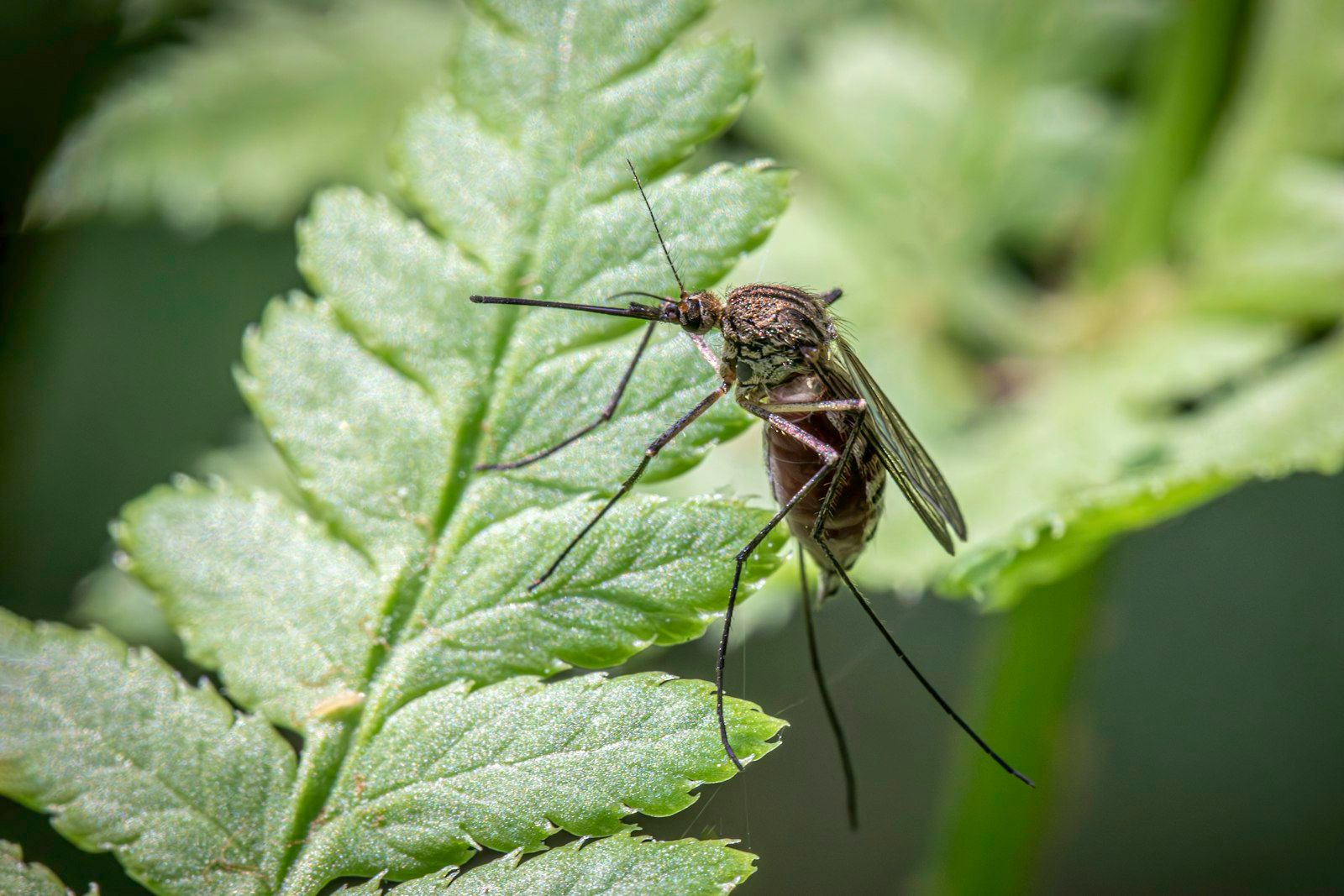
Europe's 2026 West Nile virus season has widened. The ECDC week-28 communicable disease threats report records that, as of 8 July, 11 areas affected by West Nile virus have been identified in five countries: Italy (five), North Macedonia (two), Romania (two), Greece (one) and Spain (one). Greece and Spain are first-time 2026-affected countries and Italy has gone from three to five areas, a structural mid-July expansion from the earlier three-country picture, with ECDC noting that seasonal weather conditions currently favour mosquito-borne transmission and that more cases are expected in the coming weeks. A newly indexed Italian case report of a fatal lineage-2 neuroinvasive infection presenting as Guillain-Barre syndrome, co-authored from Italy's national arbovirus reference laboratory, anchors the severity dimension. With no approved human WNV vaccine and no specific antiviral, the consumer-protection layer at the human-vector interface is the front line.
The European Centre for Disease Prevention and Control has published its week-28 communicable disease threats report, covering 6 to 10 July 2026, and its West Nile virus weekly section records a materially wider European season than the picture carried through the first days of July. As of 8 July, in ECDC's own words, "11 areas affected by West Nile virus (WNV) have been identified in five countries across Europe," and "these areas are located in Italy (five), North Macedonia (two), Romania (two), Greece (one) and Spain (one)." That is a structural mid-July expansion. Greece and Spain are first-time 2026-affected countries in the West Nile section, Italy has gone from three affected areas to five, North Macedonia has moved from one area to two, and Romania holds at two. The three-country picture recorded earlier in the season has become a five-country, eleven-area platform, and ECDC frames the trajectory plainly: "seasonal weather conditions are currently favourable for mosquito-borne transmission," so "more cases are expected to occur in the coming weeks." This is the strongest new European surveillance signal of the week, and it maps directly onto the consumer-protection layer at the human-vector interface.
What the ECDC week-28 report actually records
The figure is a single, coherent institutional statement with a clear data cutoff. The West Nile weekly section of the week-28 report is dated to the 2026 transmission season "as of 8 July," and it enumerates eleven affected areas across five countries by name and count: Italy with five, North Macedonia with two, Romania with two, Greece with one and Spain with one. ECDC's parallel weekly West Nile surveillance, on the same 8 July cutoff, records 12 locally acquired human cases across those eleven areas and five countries. The report carries ECDC's standard caveat that the counts are probable and confirmed cases reported at the NUTS3 regional level, that they are preliminary, and that they are subject to revision by the reporting countries as the season continues.
The direction of travel is the substantive point. Through the opening days of July the European West Nile surface was a three-country picture, effectively Italy, Romania and North Macedonia. The week-28 report widens that to five countries and doubles Italy's affected-area count, and it does so with two brand-new national entries. The expansion is not a single dramatic cluster; it is a broadening of the geographic base of the season across the Mediterranean and south-eastern Europe, exactly the pattern that ECDC's favourable-conditions framing anticipates. West Nile virus circulates in a bird reservoir and is transmitted to people by Culex mosquitoes, whose activity rises with warm summer conditions, so a widening footprint in mid-July is a leading indicator of where the season is heading rather than a season total.
Greece and Spain: two first-time entries, and an Iberian multi-vector note
The two new national entries carry the most editorial weight. Greece appears in the West Nile weekly section for the first time this season with one affected area, and Spain appears for the first time this season with one affected area. Both additions extend the West Nile-affected map of Europe further west and further south than the earlier three-country core, and both give the 2026 season a wider Mediterranean base than it had a week earlier.
Spain also appears a second time in the same week-28 report, in a context that is adjacent rather than central to the mosquito story. The week-28 report carries a new Crimean-Congo haemorrhagic fever weekly section, which records that "as of 8 July 2026, one country in Europe has reported locally acquired cases of Crimean-Congo haemorrhagic fever (CCHF): Spain (one case)," in Salamanca. ECDC assesses that the Salamanca case "is not unexpected as Hyalomma spp., the main vector of CCHF virus, are widely distributed across the region," and that the virus is known to circulate in local animal populations. Crimean-Congo haemorrhagic fever is tick-borne, carried by Hyalomma ticks rather than mosquitoes, and it sits outside the core mosquito-protection story, so it is noted here only as context: Spain now surfaces in both the mosquito-borne West Nile section and the tick-borne CCHF section of the same weekly report, marking the Iberian Peninsula as a widening multi-vector surface in mid-July 2026. The mosquito-borne West Nile entry is the item that matters for this frame; the tick-borne case is an adjacency, not a mosquito-protection claim.
The severity anchor: a fatal lineage-2 neuroinvasive Italian case
The surveillance expansion arrives alongside a clinical-severity signal from Italy. A case report indexed on 8 July 2026 in Clinical Neuropathology, by Mastroianni and colleagues, documents a human West Nile virus lineage-2 neuroinvasive infection that presented as a fatal case of Guillain-Barre syndrome. The report is a single Italian case, but it carries institutional weight: a co-author, C Castilletti, is affiliated with the National Institute for Infectious Diseases Lazzaro Spallanzani IRCCS in Rome, Italy's national arbovirus reference laboratory. The clinical detail is the part that pairs with the expansion. Most severe West Nile presentations are encephalitis or meningitis; this case documents a fatal outcome through Guillain-Barre syndrome, a serious neurological complication, widening the recognised severe-disease spectrum for the lineage-2 virus that circulates in Italy.
Read next to the week-28 report, the case report reinforces the reason the season expansion is worth household attention. The 12 locally acquired European cases counted as of 8 July are early-season numbers, and roughly four in five West Nile cases that come to medical attention in a typical year are the milder febrile form; but the fraction that becomes neuroinvasive can be severe, and this case documents that severity at its most extreme end in exactly the country now reporting the largest affected-area count. The editorial reading stays strictly on the surveillance-and-severity frame: a documented fatal neuroinvasive outcome is a reason to take bite prevention seriously during an expanding season, not a comment on the clinical toolkit or on the institutions doing the reporting.
Why the European expansion matters for the 2026 cycle
The week-28 expansion matters for three reasons. First, it upgrades the European West Nile peg from a stable three-country picture to a structural five-country, eleven-area platform, with two new national entries and a doubling of the leading country's affected areas, all under ECDC's explicit note that conditions favour further transmission. Second, it places the European surface alongside a United States season running at a 22-year high, so that the two continents together describe a Northern-Hemisphere-wide West Nile intensification rather than a purely regional event. Third, and most operationally, the prevention prescription is the same on both sides of the Atlantic and it is a description of the consumer-protection layer.
That third point is the heart of the story. There is no approved human West Nile virus vaccine and no specific antiviral treatment, a fact stated plainly by public-health authorities including the United States Centers for Disease Control and Prevention, whose current-year dashboard, data current to 7 July 2026, records 48 human cases across 23 states with Arizona's Maricopa County as the epicentre. The absence of a licensed medical countermeasure for this particular pathogen is not a failure of the countermeasure pipeline; it is the structural reason that preventing a mosquito bite is, in the authorities' own framing, the reliable line of prevention this season. The recommended precautions, an EPA-registered insect repellent, avoiding exposure between dusk and dawn when the Culex vectors are most active, and window and door screens and air conditioning to keep mosquitoes out of living spaces, are a description of the consumer-protection layer: repellents, physical barriers and behavioural timing, operating at the point where a mosquito would otherwise reach a person. A season that has widened to five countries with favourable conditions ahead is precisely the setting in which that layer earns its place.
What the expansion does NOT say
The frame should be as disciplined as the data. The eleven-area, five-country figure is an as-of-8-July count, preliminary and subject to country revision, not a season total or a forecast. The 12 locally acquired cases are early-season European numbers, and they do not transfer numerically to any other continent; the United States season is tracked separately through CDC. The two new national entries, Greece and Spain, are first-time appearances in the 2026 weekly section at one area each, which is a signal about geographic spread rather than a claim of large local outbreaks. The Italian case report is a single documented fatal outcome, an anchor for the severe end of the disease spectrum, not a population-wide severity rate. The Salamanca CCHF case is a tick-borne signal noted only for Iberian multi-vector context; it is not a mosquito-borne claim and does not belong to the West Nile count. And nothing here is a comment on the vaccine or antiviral pipeline, on vector-control programmes, or on the surveillance authorities: ECDC's West Nile and CCHF weekly sections and CDC's dashboard are treated as the authoritative surfaces they are, and the consumer-protection framing rests on the human-vector interface, not on any judgement about upstream medical countermeasures or about any country's public-health response.
What to watch next
The 2026 week-28 platform should track four near-term developments. First, the separate ECDC weekly West Nile surveillance report, updated each Friday during the transmission season, and the week-29 communicable disease threats report expected around 17 July, will show whether the five-country, eleven-area platform widens further and whether per-region case counts climb across the Italian, North Macedonian, Romanian, Greek and Spanish areas. Second, the ECDC CCHF weekly section will indicate whether the single Salamanca case remains isolated or expands. Third, the EpiCentro Istituto Superiore di Sanita 2026 West Nile and Usutu bulletin, historically expected around mid-July and still at its 2025 season-final edition, will record the Italian season directly and test whether the reporting catches up with the country's now-five affected areas. Fourth, the consumer-protection editorial frame should pair each surveillance update with practical guidance built on exactly the measures the authorities recommend, EPA-registered repellent, window and door screens, and dusk-to-dawn caution, for households, travellers and outdoor workers across the Culex transmission zones of southern and south-eastern Europe.
The consumer-protection layer for the 2026 West Nile season is the in-season complement to the surveillance signal reported by ECDC. The expansion to five countries and eleven areas explains why vector activity and viral circulation are broadening under warm mid-July conditions; the fatal lineage-2 neuroinvasive Italian case explains why the severe end of the disease spectrum is worth respecting; and the consumer-protection layer operates at the human-vector interface, at the window screen, the repellent application and the dusk-to-dawn timing, independent of the fact that no West Nile vaccine or antiviral is available for this pathogen. The two are complementary rather than substitutable. The durable message is that the physical barrier is the layer available now, for everyone, with no supply ceiling and no excluded cohort, and it is the consumer-protection framing that pairs with the widening European surveillance picture without supplanting it, as the 2026 Culex-borne West Nile season moves toward its historical late-summer peak across an now-wider map.
Published 2026-07-12 · Mosticare Editorial