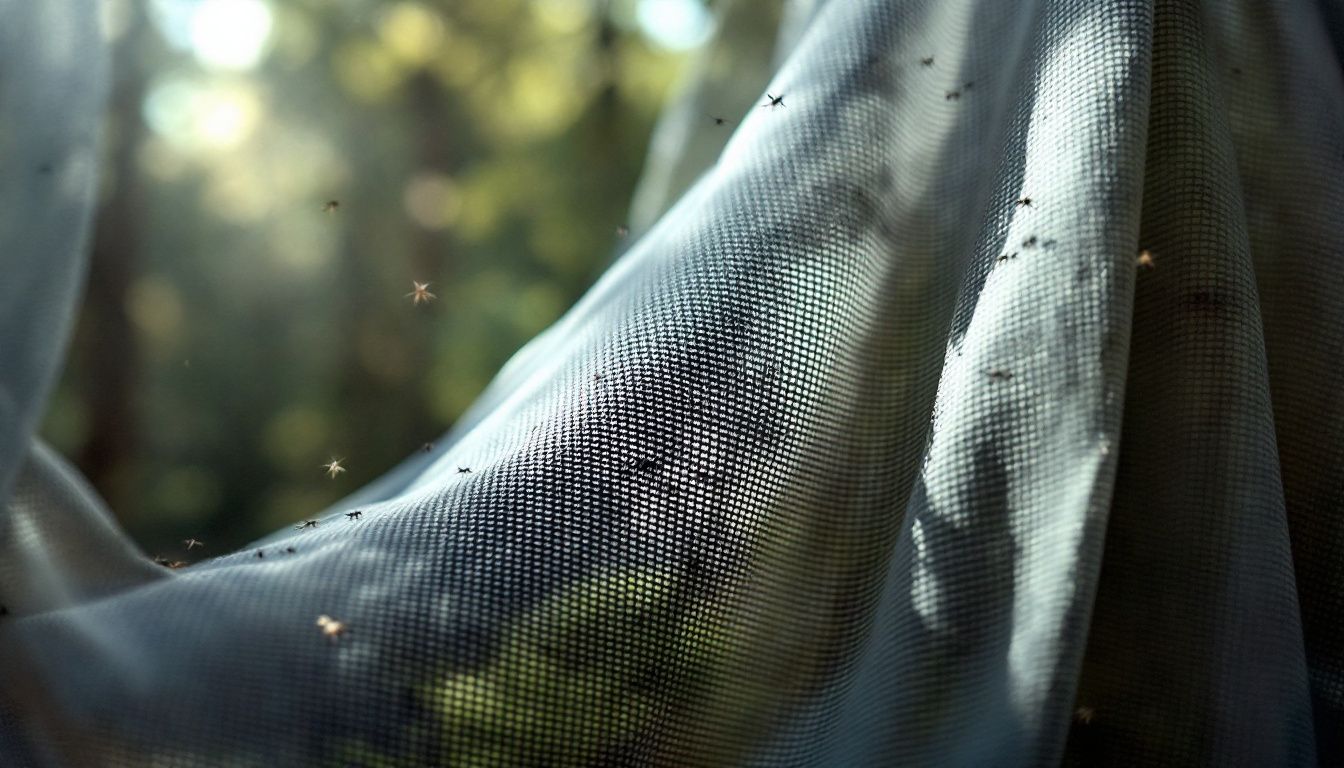
A consumer-side explainer of the treated-mosquito-net regulatory frame: what EU BPR authorisation is (and is not), what WHO prequalification is (and is not), the five-point trust-signal check to apply on a label or product page, and why permethrin-treated nets are appropriate for some uses (travel to high-risk destinations) and not for others (a baby's cot or pram).
If you are shopping for a treated mosquito net for your family - for travel, for a holiday home, for a veranda that holds the evening breeze and the tiger mosquitoes with it - the question that has stopped being simple is which one to trust. The European market now carries treated nets from at least a dozen manufacturers, sold under at least four different regulatory claims, with product pages that use the words "WHO" and "EU authorised" in ways that do not all mean the same thing. Some of those claims are real and verifiable. Some are not.
This article sets out what a family should actually look for on the label and on the product page, and why the difference between a real regulatory claim and a marketing echo of one is a question worth ten minutes of reading before you buy a treated net.
It is only about treated mosquito nets. Untreated mosquito nets, gazebos, cot and pram canopies, pop-up nets and head nets are untreated physical barriers. They are not biocidal products. EU BPR authorisation, WHO prequalification, and the active-ingredient chemistry of permethrin do not apply to them, and this article does not extend those claims to them by reference. Every statement about BPR, WHO and permethrin below is scoped to treated mosquito nets on the European market.
What "treated mosquito net" actually means
The mosquito net universe splits into two product classes with very different regulatory profiles. The boundary between them is the regulatory boundary, and a parent's reading of the label depends on which side of that boundary the product sits on.
An untreated mosquito net is a physical barrier. It keeps mosquitoes away from the people inside it by virtue of the mesh. It does not carry an EU biocidal-product authorisation, it does not carry a WHO vector-control product listing, and it does not contain an active insecticidal ingredient. It is the appropriate choice for routine infant protection in a non-endemic European home, the under-six-months rule, the crib canopy, the pram net. It is the appropriate choice for an untreated gazebo on a terrace. None of the regulatory claims in this article apply to it.
A treated mosquito net is a biocidal product. It carries a factory-applied insecticidal active ingredient - permethrin, in the European consumer market - that repels and kills mosquitoes on contact with the mesh. Because the mesh itself is doing the insecticidal work, the finished product is regulated as a biocidal product under the EU Biocidal Products Regulation (BPR). It is appropriate for the use cases BPR was written for: long-lasting insecticidal nets (LLINs) deployed in vector-control programmes against malaria-carrying Anopheles in endemic regions, and treated-article consumer products sold to European households with the appropriate label scope.
The first question for a parent or household buyer is therefore not "is this a good mosquito net" but "is this a treated mosquito net or an untreated mosquito net" - because the regulatory frame, the labelling requirements, the protective mechanism, the appropriate-use population, and the warnings on the box are all different.
What EU BPR authorisation is, in one paragraph
The EU Biocidal Products Regulation (BPR), Regulation (EU) No 528/2012, is the EU regulation that governs biocidal products and the active substances they contain. It defines 22 product types ("PTs"). Treated mosquito nets sit in PT18 - Insecticides, acaricides and products to control other arthropods. PT19 - Repellents and attractants - covers skin-applied repellents and does not apply to treated nets.
For a treated net to be placed on the EU market legally, two things must be true:
- The active substance - permethrin, in the consumer-treated-net category - must be approved at EU level under the BPR active-substance review programme run by the European Chemicals Agency (ECHA) through its Biocidal Products Committee (BPC).
- The finished product - the specific treated net - must hold either a Union authorisation under Article 58 (treated articles) or a national authorisation in the Member State of placement. The authorisation reference number appears on the label and on the EU BPR register (R4BP 3).
A treated mosquito net on a European shop shelf without either of those two records is, by definition, not EU BPR-authorised. The "EU authorised" wording on the box is a regulatory statement with a verifiable identity behind it.
What WHO prequalification is, and what it is not
The World Health Organization Prequalification Programme for Vector Control Products evaluates vector-control products such as insecticide-treated nets against WHO specifications (WHO). In the EU, treated mosquito nets sit under the Biocidal Products Regulation, which requires that the active substances in a treated article are approved before the product is placed on the market (EUR-Lex). WHO prequalification is a separate regulatory track from EU BPR. Because the two programmes are separate, a product can hold one without the other.
WHO prequalification is a listing, not a certification. A listed product appears in the WHO Prequalification Team register; the listing reflects a positive evaluation against WHO specifications. Listing is a meaningful trust signal for humanitarian procurement agencies and for the global health supply chain. It is not, on its own, an EU regulatory authorisation.
For European consumer-treated-net buyers, the practical reading is:
- "EU BPR authorised" - verifiable on the ECHA R4BP 3 register under the authorisation number. This is the EU regulatory record.
- "WHO prequalified" - verifiable in the WHO Prequalification Team listing. This is the global-health procurement listing.
- "Built to WHO standards" or "WHO specification" - an engineering reference statement, not a regulatory listing. The product is built to the WHO LLIN specification, but the manufacturer does not hold a WHO Prequalification Programme listing. This wording is honest if it is what is meant, but it is not the same as "WHO prequalified" and the two should not be conflated.
The distinction is editorial, not technical: a household buyer reading a product page should be able to tell which of these three statements is being made. "WHO standards" means the engineering reference. "WHO prequalified" means the listing. They are not interchangeable.
What permethrin is, and what the regulatory controls on it look like in 2026
The active insecticidal ingredient in the European consumer-treated-net category is permethrin, a synthetic pyrethroid. Permethrin has been approved as an active substance under the BPR for PT18 for many years, and the European consumer-treated-net category has been built around it. Pyrethroids as a class - permethrin, deltamethrin, alpha-cypermethrin, lambda-cyhalothrin - are the dominant chemistry in the long-lasting insecticidal net (LLIN) category worldwide.
The regulatory status of permethrin in 2026 is:
- Active-substance approval under the BPR is currently in a rolling 2026-2027 pyrethroid review programme at ECHA's Biocidal Products Committee. The current non-approval extension - that is, the period during which existing authorisations continue while the review runs - runs through October 2028.
- Permethrin is on ECHA's list of Candidates for Substitution under BPR Article 10(1). The flag is a procedural note attached to the substance's approval conditions; it is not a recall, a phase-out, or a market-withdrawal action. It becomes editorially relevant when an authorisation comes up for renewal, at which point a comparative assessment is performed. For products with valid authorisations in 2026, the flag does not change the label, the user instructions, or the protective function of the net.
- Product authorisations are independent of the active-substance review. A treated mosquito net with a current EU BPR product authorisation remains on the EU market on the published terms of that authorisation, even while the active-substance review is in progress. If the active-substance approval were not renewed at the end of the review window, every permethrin PT18 product on the EU market would be affected; that is a forward risk watch, not a current market action.
A treated-net buyer in 2026 reading a label should expect to see permethrin listed as the active substance, its concentration, the target species named on the label, and the authorisation reference number that ties the finished product to the EU BPR register.
The trust-signal framework - what to check on a treated-net label or product page
Five checks turn "EU BPR authorised" or "WHO prequalified" from a marketing echo into a verifiable claim.
1. The authorisation number. A treated mosquito net placed on the EU market under BPR carries an authorisation reference number on the label and on the manufacturer's regulatory file. The reference should resolve to an entry in ECHA's R4BP 3 register under the product-type PT18. If the reference number is not on the label, or does not resolve in the register, the claim is not verifiable.
2. The active-substance declaration. The label must state the active substance and its concentration, as the BPR requires for a biocidal product. A treated net whose label does not declare the active substance is not compliant with the BPR labelling rules for PT18.
3. The appropriate-use population. A treated mosquito net sold in Europe is authorised for a defined appropriate-use population, which is not "all households". Treated nets are intended for use against the mosquitoes the BPR label specifies. Treating a baby's cot or pram with permethrin changes the regulatory class of the product and is outside the scope of the BPR authorisation for the consumer-treated-net category. For routine infant protection in a non-endemic European home, an untreated canopy is the appropriate choice, not a treated net. The label of any treated net sold in Europe will make this clear if it is read in full.
4. The "Candidate for Substitution" footnote, if present. Permethrin's Candidate-for-Substitution status under BPR Article 10(1) is part of the public record. It is not a withdrawal, a recall, or a phase-out. A product page that lists the authorisation number and the ECHA register entry is providing the verifiable record; a product page that uses the Candidate-for-Substitution status as a reason not to buy is misreading the regulatory language.
5. The manufacturer's regulatory file. A manufacturer that places treated mosquito nets on the EU market should be able to produce, on request, the SPC (Summary of Product Characteristics) for the authorisation, the factory impregnation rate certificate, and the most recent regulatory monitoring update. A verifiable regulatory file will name the authorisation number, the product coverage, and the active-substance review window; the absence of one is itself a signal.
Trust signals vs unregulated imports
The reason the trust-signal framework matters is that the European market now contains treated mosquito nets that are not EU BPR-authorised and not WHO-prequalified. They are sold under the words "insecticide-treated", "long-lasting", "WHO formulation" and similar, often at price points below the regulated products, often by importers whose regulatory file is not verifiable. The buyer cannot tell from the box whether the product has been through the BPR active-substance approval and the EU product authorisation; the box looks the same.
The risk in buying an unregulated treated mosquito net is not that the net does not work. The risk is that:
- The factory impregnation rate is not declared and is not what the box claims.
- The active substance is not what the box claims - substituted with a pyrethroid that is not approved for PT18, or with a non-pyrethroid chemistry that has not been through the BPR review.
- The label does not match the SPC, so that the use conditions on the box are not the use conditions that were evaluated by the regulator.
- There is no market-surveillance trail. If a treated net causes an adverse reaction in a household member, the importer has no SPC to refer to and no authorisation number to attach to the adverse-event report.
EU BPR authorisation is the regulatory layer that exists to make these failure modes detectable. WHO prequalification is the parallel global-health layer. A treated mosquito net without either is not regulated as a biocidal product anywhere.
The treated-net buying decision in plain language
Three operational takeaways:
- The treated-net category is regulated. EU BPR authorisation and WHO prequalification are verifiable records. The label should carry an authorisation number that resolves in ECHA's R4BP 3 register. If the number is not on the label or does not resolve, the claim is not verifiable.
- The current status is calm, not in crisis. The permethrin PT18 active-substance review is running at ECHA on a calendar that extends through October 2028. Product authorisations remain in force on their published terms. There is no in-force market action affecting treated mosquito nets on the EU market in 2026, and no current withdrawal.
- The treated-net category suits some uses, not all uses. It is appropriate for the uses the BPR label specifies. It is not appropriate for an infant's cot or pram, where an untreated canopy is the suitable choice. A household buyer who treats a treated net as a substitute for an untreated canopy is moving to a more restrictive regulatory class, not a less restrictive one.
The scope guardrail - what this article does not address
This article is about treated mosquito nets. It does not address, and its claims do not extend by reference to, untreated physical barriers:
- Untreated gazebos and terrace enclosures are untreated physical barriers. They are not biocidal products.
- Cot and crib canopies are untreated physical barriers. They are not biocidal products.
- Untreated pop-up nets and head nets are untreated physical barriers. They are not biocidal products.
- Untreated bed and travel nets are untreated physical barriers. They are not biocidal products.
EU BPR authorisation, WHO prequalification, and the active-ingredient chemistry of permethrin do not apply to any untreated net. No GOTS or OEKO-TEX certification is claimed for any treated or untreated net. No partnership or endorsement by any research institute is claimed. The consumer-guidance reading set out in this article covers the EU regulatory record for the treated-article category only; the under-six-months decision for infant protection is a separate question.
Where to read next
For the authoritative record behind the trust-signal checks in this article, consult the primary regulators directly: ECHA's Biocidal Products Regulation portal and R4BP 3 register for product authorisations, and the World Health Organization Vector Control Product Prequalification register for LLIN listings.
Sources
- European Chemicals Agency (ECHA). Biocidal Products Regulation portal and R4BP 3 register. Treated-article authorisations under Article 58 (PT18).
- European Commission. Regulation (EU) No 528/2012 - Biocidal Products Regulation (BPR). The framework for active-substance approval, product authorisation and treated articles.
- European Chemicals Agency. Biocidal Products Committee (BPC) opinion register. Pyrethroid PT18 review programme, 2026-2027 cycle.
- European Chemicals Agency. Candidates for Substitution under BPR Article 10(1). Current permethrin entry.
- World Health Organization. Vector Control Product Prequalification Programme. LLIN specifications referenced.