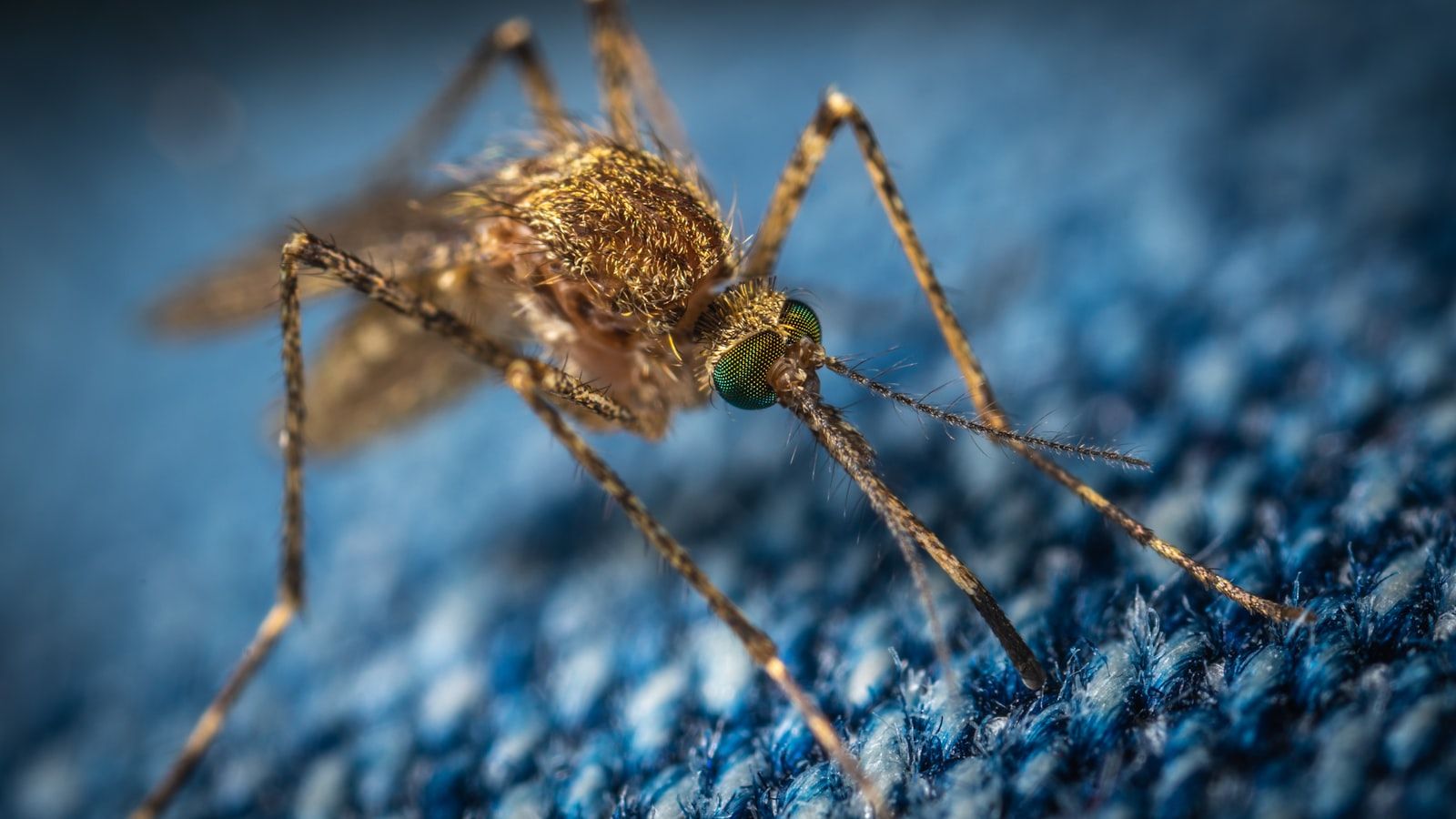
When you picture the places mosquitoes are taking over, you probably picture the tropics. A new model of 29 Aedes species, built from 878,954 occurrence records, says the map is upside down: the regions set to gain the most newly suitable habitat this century are temperate, with Europe and North America at the centre. Across four climate scenarios, more than 70% of the world's land becomes friendlier to these mosquitoes. The tropics are already warm enough; the frontier is at the cooler edges that are only now crossing the threshold. Suitability is not destiny, but the direction is clear.
When you picture the places mosquitoes are taking over, you probably picture the tropics. A new modelling study of 29 mosquito species says you have the map upside down. The regions set to gain the most newly suitable habitat this century are not equatorial, they are temperate. Europe and North America sit at the centre of it.
The finding comes from a team at Dali University in China, published in the journal Insects, who assembled 878,954 records of where 29 Aedes species actually live and asked a simple question: as the climate warms, where does the overlap of suitable conditions for these mosquitoes grow, and where does it shrink? The answer is unsettling not because it is loud, but because it is specific.
What the model found
Across four future-climate scenarios, the researchers detected a substantial rise in habitat suitability across more than 70% of the world's land, precisely, 77.55%, 71.32%, 76.61% and 72.18% of the global terrestrial area, excluding Antarctica, depending on the scenario. Put plainly: under every pathway they tested, the share of the planet's land becoming friendlier to Aedes mosquitoes lands somewhere between seven and eight parcels in ten.
That is the headline number, and it deserves a moment of scepticism before we accept it, because big round figures invite it. This is a model, not a census. It projects suitability, the climatic conditions a mosquito can tolerate, not actual infestation. A place becoming suitable is a place where the mosquito could establish if it arrives, not proof that it has. The distinction matters. But it is exactly the distinction that makes the geography so striking.
Because the model does not spread the gains evenly. The "main body" of the highest-increase regions sits squarely over North America and Europe, with further expansion projected across Africa outside its desert belts, eastern China, tropical Asia, and the south-eastern coast of Australia. Three species, Aedes aegypti, the yellow-fever and dengue mosquito; Aedes albopictus, the tiger mosquito Europeans are now meeting in person; and Aedes vexans, showed the widest ranges across every scenario.
Why the temperate world, not the tropics
The logic, once stated, is obvious. The tropics are already warm enough for these mosquitoes; there is little room left to gain. The frontier of expansion is therefore at the edges, the temperate latitudes that were, until recently, simply too cool for an Aedes population to survive the year. As those edges warm, they cross a threshold, and a place that could never host a tiger mosquito suddenly can. The biggest changes happen where the change is newest.
The researchers tested this under two climate models and two emissions pathways, an optimistic SSP126 and a pessimistic SSP585, running the projections out to the year 2100. Crucially, they found that climatic factors influenced these range shifts more strongly than any other variable. This is not a story about trade routes or urbanisation, though both matter. It is, at its core, a temperature story.
What this means on the ground
For a reader in Lyon, Milan or Frankfurt, the abstraction collapses into something concrete. The tiger mosquito is no longer arriving, it has arrived. France's enhanced surveillance now covers most of the country; the species has been confirmed as far north as Berlin. This study supplies the longer arc behind those headlines: the conditions that let Aedes albopictus settle in are not a freak of one warm summer but a trend with a direction, and the direction is poleward and upward.
The danger the authors flag is not the mosquito alone. It is the mismatch between where the mosquito is heading and where the immunity and the infrastructure are. Outbreaks are likeliest where populations have never met these viruses and where public-health systems are not yet built to expect them, which describes much of newly suitable Europe and North America rather well. A tropical city has decades of dengue muscle memory. A temperate one does not.
That is also where the more hopeful reading lives. A projection to 2100 is a long runway, and suitability is not destiny. The mosquito needs somewhere to breed before it can establish, and the places it favours, standing water in saucers, blocked gutters, discarded tyres, forgotten buckets, are precisely the ones within ordinary human control. Singapore has shown that determined source reduction and modern vector control can suppress Aedes populations even in ideal climates. The map tells you where the pressure is coming. It does not oblige you to lose.
What to watch next
This is the second major range-shift projection to land on our desk in as many weeks, a separate analysis recently put five billion people inside dengue-mosquito territory decades ahead of earlier forecasts. When independent teams, using different data and different methods, keep arriving at the same direction of travel, the individual percentages matter less than the consensus they point to. The interesting question is no longer whether temperate Europe becomes Aedes country. It is how quickly surveillance, source reduction and household protection scale to meet it. Watch the European mosquito-monitoring bulletins through this summer: each new northern detection is a small, real-world data point against a very large model.
What we know
Sources cited
- Zhang, Mei, Nie, Hu & Feng (Dali University). Insects 2025; 16(5):476 (published 30 April 2025). DOI: 10.3390/insects16050476. https://doi.org/10.3390/insects16050476
- PubMed Central open-access copy. https://pmc.ncbi.nlm.nih.gov/articles/PMC12111898/