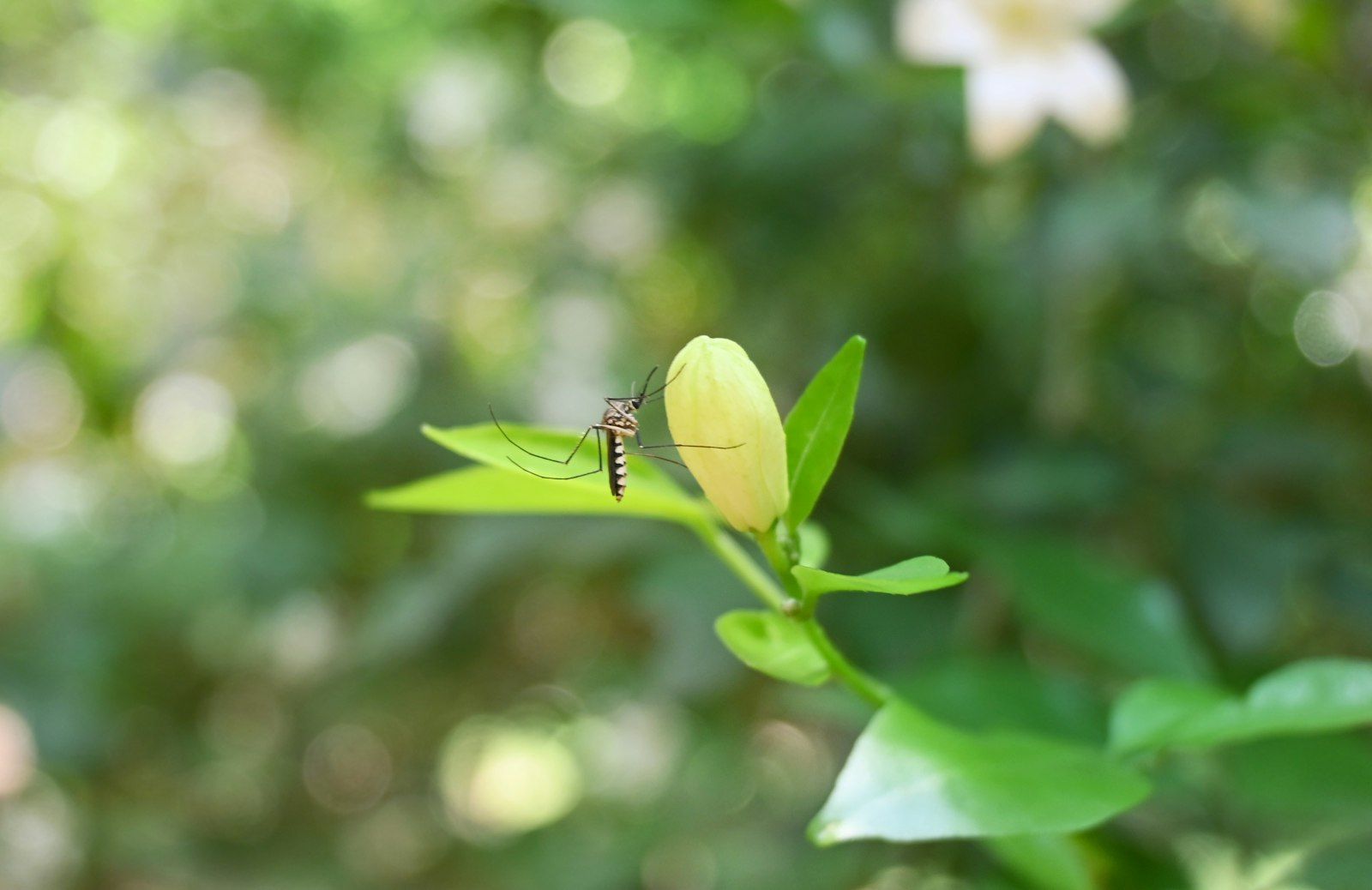
The Asian tiger mosquito travels in the footwell of a car, a stack of used tyres, the saucer under a balcony pot. According to two studies published in the past year, the climate of five European capitals, Paris, Vienna, Frankfurt, London and Zagreb, has now warmed enough to let it stay. That is the quiet headline of the 2026 season: not an outbreak, a threshold crossed. Europe recorded its largest season of locally acquired chikungunya in 2025, and then stamped the clusters out. Both halves of that sentence are true at once, and the leverage sits with surveillance and standing water.
The Asian tiger mosquito does not own a passport. It travels in the footwell of your car, in a stack of used tyres, in the saucer under a balcony pot. And according to two studies published in the past year, the climate of five European capitals, Paris, Vienna, Frankfurt, London and Zagreb, has now warmed enough to let it stay.
That is the quiet headline of the 2026 mosquito season. Not an outbreak. A threshold, crossed.
The map has changed twice
The first study, published in Global Change Biology by Arianna Radici, Cyril Caminade and colleagues, tracked the spread of Aedes albopictus, the tiger mosquito, across France and western Europe. The mosquito arrived in a single French département in 2004. It is now advancing 10 to 40 kilometres a year. By the 2010s, southern Europe offered suitable conditions for it to establish; by the 2020s, much of western Europe did too. The cities the authors flag as "newly suitable" are not tropical backwaters. They are Paris, Vienna, Frankfurt, London and Zagreb.
The second study, published in Frontiers in Cellular and Infection Microbiology by Qiang Zhang and a team including Ye Xu of Zhejiang Chinese Medical University, asked a connected question: where could chikungunya, the painful, occasionally debilitating virus the tiger mosquito carries, actually be transmitted? Using 16 IPCC climate scenarios and projections running to 2100, the researchers found that 139 countries, covering 21.26% of the world's land surface, already sit in the risk zone. Three regions emerge again and again as future hotspots: north-central Europe, north-eastern North America and eastern Asia.
The mechanism is unromantic. Warmth speeds the virus up. Between roughly 18°C and 28°C, chikungunya develops inside the mosquito four to five times faster than in cooler conditions, which means a mosquito that bites an infected person is ready to pass the virus on sooner, before it dies. Unlike its tropical cousin Aedes aegypti, the tiger mosquito tolerates a European spring. That single trait of cold tolerance is what moves the line north.
It is already happening, and it is already being contained
This is the part the alarmist version of the story leaves out.
Europe did not wait until 2100. In 2025 the continent recorded its largest season of locally acquired chikungunya yet. France logged 637 cases across 68 separate clusters; Italy logged 323 cases across four. Many of those French cases traced back to travellers returning from a major epidemic on the island of Réunion. Globally, 2025 was severe: 502,264 reported cases across 41 countries and territories, and 186 deaths, according to figures cited by Euronews.
And then, this matters, the clusters closed. The ECDC's chikungunya monitoring reports Europe's record 2025 transmission as fully ended. So far in 2026, global numbers are running far lower: roughly 33,000 symptomatic cases and nine deaths, concentrated in South America.
So the honest summary is not "a plague is coming." It is this: the conditions for local transmission now exist in places that had never worried about it, the first real clusters have appeared, and public-health systems have so far managed to stamp them out. Both halves of that sentence are true at once.
What it actually takes for an outbreak
Chikungunya does not arrive on the wind. It needs two things in the same place: a person carrying the virus, usually after travelling from somewhere it is endemic, and an established population of mosquitoes ready to bite them and bite the next person. Climate change supplies the second ingredient. Air travel supplies the first.
That is oddly reassuring, because it tells you where the leverage is. Break either link and the chain fails. A city with good surveillance, one that finds the first case fast and removes mosquito breeding sites around it, can close a cluster before it becomes a season. That is precisely what France and Italy did in 2025.
For an ordinary household, the lesson is smaller and duller than a news alert suggests, and far more useful. The tiger mosquito breeds in tiny volumes of standing water close to where people live: blocked gutters, plant saucers, watering cans, the forgotten bucket behind the shed. It rarely flies more than a couple of hundred metres in its life. The mosquito biting you on a Lyon balcony was very probably born on that balcony. Tip out the standing water and you remove the nursery. Where you cannot avoid the mosquito, a physical barrier between it and your skin remains the one method that neither breeds resistance nor sprays chemicals into the air, the approach Mosticare has always argued for, and the approach the science keeps quietly endorsing.
The authors of both studies make the same plea, and it is worth hearing. They want surveillance strengthened and epidemiological data shared with researchers, so that the models predicting where the mosquito goes next can be sharpened against what actually happens. The maps are only as good as the reporting that feeds them.
What to watch next
The ECDC publishes a weekly arbovirus bulletin every Friday through the season. As of early June, the related watch on West Nile virus showed only a single 2026 human case in Europe, a reminder that "suitable for transmission" and "transmitting" are not the same thing. The question for chikungunya is whether 2026 produces its first locally acquired European cases, and when. The next bulletins through June and July will answer it.
The longer story is the one the two studies have already told. The tiger mosquito has reached the latitude of Paris. It is not leaving. What happens next depends less on the climate, which is now largely set for this decade, and more on whether Europe's cities treat surveillance and standing water as seriously as the mosquito treats a saucer of rainwater.
What we know
Sources cited
- Euronews Health, "Heat may bring chikungunya virus to Europe, study warns," 27 May 2026, https://www.euronews.com/health/2026/05/27/europe-could-become-a-chikungunya-virus-hotspot-as-climate-change-expands-mosquito-habitat
- European Commission (Environment), "Paris, Vienna, Zagreb and other European cities will be at more risk of dengue, Zika and chikungunya," 14 January 2026, https://environment.ec.europa.eu/news/paris-vienna-zagreb-and-other-european-cities-will-be-more-risk-dengue-zika-and-chikungunya-2026-01-14_en
- Zhang Q. et al., Frontiers in Cellular and Infection Microbiology, 2026, https://doi.org/10.3389/fcimb.2026.1808175
- Radici A., Caminade C. et al., Global Change Biology, 31(8), 2025, https://doi.org/10.1111/gcb.70414
- ECDC, chikungunya monthly overview, https://www.ecdc.europa.eu/en/chikungunya-monthly