A plug-in mosquito diffuser releases a low dose of insecticide into the air you breathe all night, in a room you have deliberately closed. Convenience is the selling point. The part nobody has cleanly quantified is what repeated overnight exposure adds up to for the way people actually use these devices. Here is the honest picture, and the barrier alternative that goes nowhere near your lungs.
This article is general information, not medical advice. If you have a specific health concern about indoor insecticide exposure, speak to a qualified clinician or pharmacist.
You close the window because it is warm and the mosquitoes are out. You switch on the little plug-in device on the wall, the one with the blue light and the refill that lasts thirty nights. It hums quietly, warms a wick, and fills the room with something you cannot smell. Then you sleep in that room for eight hours, and you do it again the next night, and the night after that, for a whole summer.
That is the product. A sealed room, a warm wick, and a chemical you inhale while you are unconscious. It is sold as the easy option. We want to be honest about what "easy" is standing in for here.
What is actually in the air
Most plug-in mosquito vaporisers work by heating a liquid or a mat that carries a synthetic pyrethroid, very often prallethrin, sometimes alongside a related compound. The device volatilises the active ingredient so it disperses through the room. That is the whole mechanism: continuous, low-level release of an insecticide into the air of an enclosed space, on purpose, for hours at a time.
Prallethrin is a real, approved active for indoor use. It is authorised as an active substance under the EU Biocidal Products Regulation for product-type 18, the insecticides category, and vaporiser products are placed on the market on that basis, subject to risk-mitigation conditions. At the doses these devices emit it is not the drama that a burning coil is. We are not going to tell you a plug-in is poisoning your family, because that is not true and fear is not our business. What we will say plainly is this: the thing being sold to you is convenience, and the thing you are actually buying is a low-dose exposure that repeats, in a room you have deliberately sealed, night after night. Those are not the same purchase.
The gap the marketing steps over
Here is the honest part that the packaging leaves out. Single-use safety and repeated overnight exposure in a closed bedroom are different questions, and the second one is less cleanly settled than the first.
Authorisation means a regulator judged a defined use acceptable against a defined risk assessment. It does not mean anyone has published a clean, final number for what a small child, or an adult with asthma, inhales across a hundred sealed summer nights with the window shut. Researchers have looked, and they have found signal, not just silence: in a study of human volunteers, repeated real-world exposure to prallethrin and the related compound allethrin was associated with measurable changes in plasma biochemistry. That is not proof of harm at the level a single household sees, and we will not dress it up as one. It is evidence that the cumulative, real-world bedroom exposure is the part that is genuinely worth characterising better, and we would rather tell you that than pretend the sticker on the box has already answered it.
So the honest framing is not "this is dangerous." It is "this is a convenience being sold over an exposure that is less well quantified for the way you actually use it than the marketing implies." When the unknown is on the product's side of the ledger and the confidence is all in the advertising, that is worth naming.
Where plug-ins sit in the aisle
To be fair to the category, a plug-in is not a citronella candle pretending to protect you. Scented candles and most botanical repellents are marginal: in the benchmark comparative repellent trial in the New England Journal of Medicine, botanical products protected for under twenty minutes on average, while DEET gave by far the longest complete-protection time. Repellents that work, like DEET and picaridin, are effective but they are a supplement you have to reapply, not a barrier. A plug-in is also not a coil, which you set alight indoors: burning a single mosquito coil releases fine particulate (PM2.5) equivalent to burning between 75 and 137 cigarettes, a clear indoor-air and respiratory harm that a diffuser does not carry.
A plug-in sits in its own spot. At close range in a small room it does have a repellent and knockdown effect, so it probably does something to the mosquitoes. It does it by asking you to breathe a low dose of insecticide all night in a room you have closed. Effective enough, at a cumulative cost you were never given a number for.
The alternative that does not go in your lungs
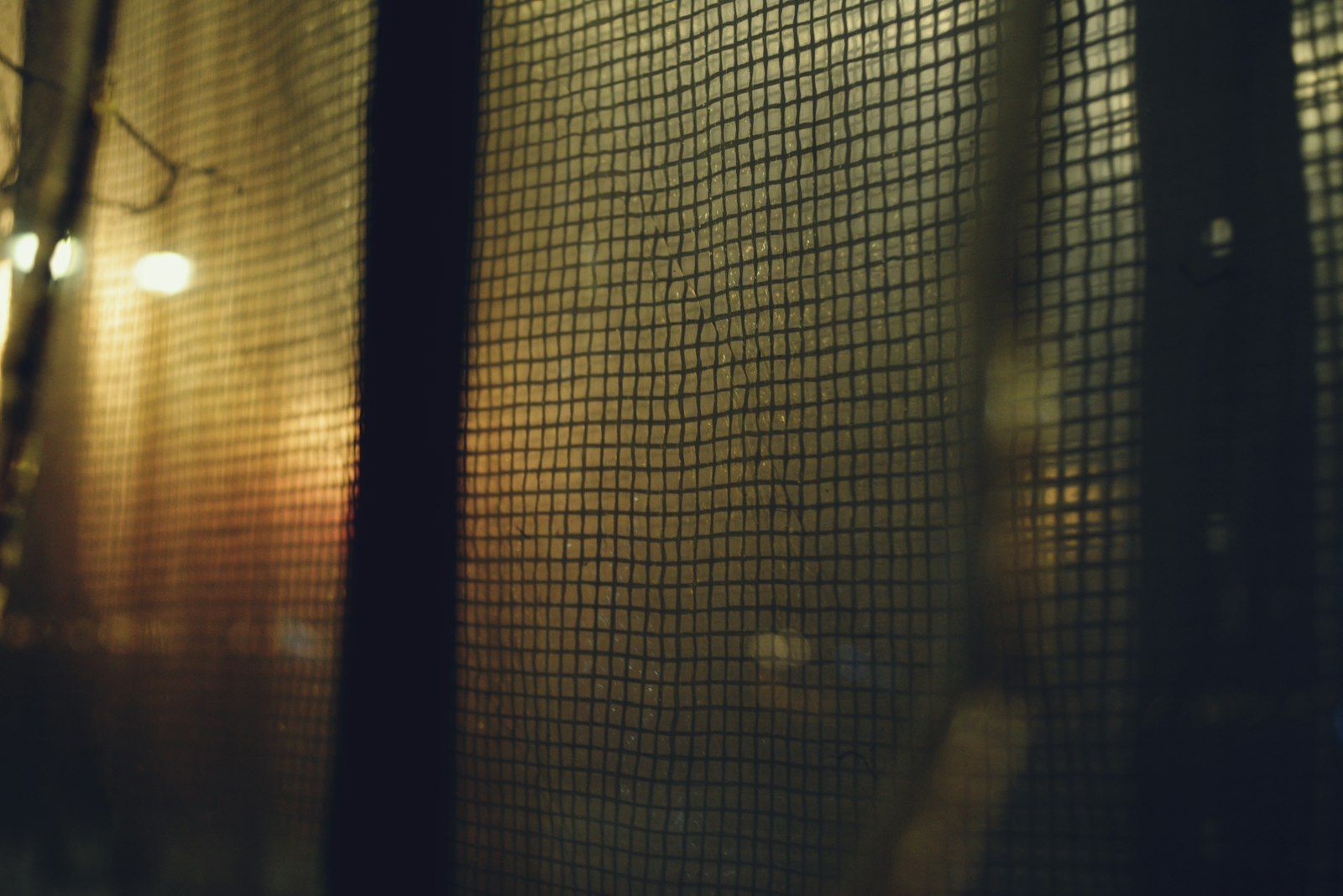
There is a mode of protection that skips this problem entirely, and medicine keeps returning to it because it is simple: a physical barrier. A well-made net or screen puts a textile mesh between you and the mosquito. Nothing to inhale, nothing to warm on a wick, nothing accumulating in a sealed room. You can open the window.
There are two kinds of net. An untreated net is pure barrier, with nothing on the mesh at all. A treated bed net adds an insecticide, usually a pyrethroid such as permethrin, bound into the fibre (CDC, insecticide-treated nets; US EPA, permethrin and other synthetic pyrethroids). Bound into a fibre you sleep under is a different exposure route from volatilised into the air you breathe, and we will not blur the two.
We will also tell you the limit out loud: a net protects a bed, a balcony, an enclosure. It does not clear a breeding site, and it is not a plug-in's plug-it-in-and-forget convenience. It is a barrier you can trust because you can see exactly what it is, and there is nothing in the air you have to take on faith.
This matters because the stakes are real without being a reason to panic. Mosquito-borne diseases kill hundreds of thousands of people a year, the great majority through malaria, with the WHO estimating about 610,000 malaria deaths in 2024 alone. Dengue and chikungunya, once considered distant, are now transmitted locally in parts of southern Europe as the tiger mosquito spreads north. Chikungunya is disabling rather than commonly fatal, but the direction of travel is clear enough that honest protection is worth getting right. That is exactly why the choice between breathing an insecticide and putting a mesh between you and the bite deserves a straight answer rather than a marketing one.
Sources: Fradin & Day 2002, comparative repellent efficacy, NEJM | Liu et al. 2003, mosquito coil emissions, Environmental Health Perspectives | Narendra et al. 2008, prallethrin and allethrin human exposure, Chemosphere | EU BPR prallethrin (product-type 18) approval summary | WHO malaria fact sheet | ECDC mosquito-borne diseases in Europe | CDC, insecticide-treated nets | US EPA, permethrin and synthetic pyrethroids
Mosticare produces structural mosquito-barrier solutions for residential, travel, and institutional markets across Europe.
This article is general information, not medical advice. Ask a doctor or pharmacist about your own health.