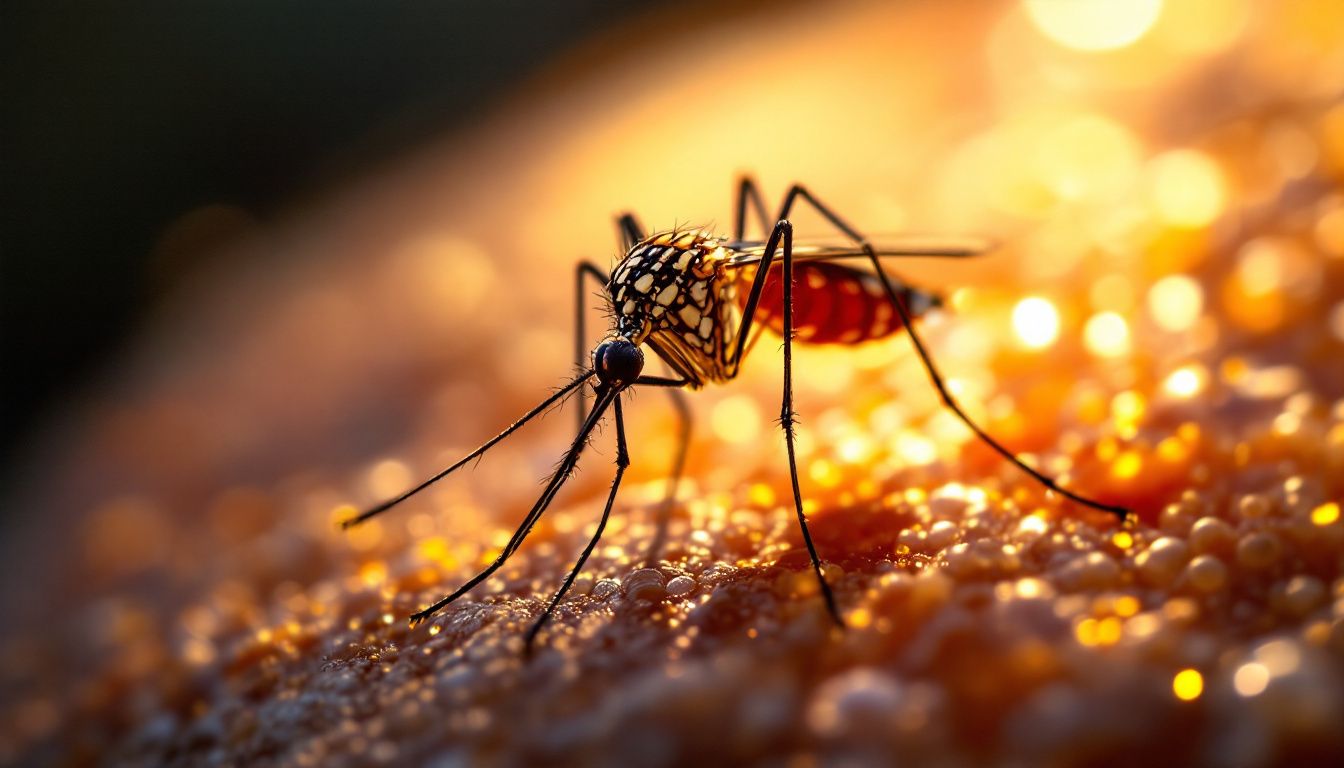
Italy's Aedes control programme in summer 2026 brings together X-ray sterilisation in Bolzano, a sterile-male pilot in Bologna, and municipal Aedes albopictus plans, while surveillance confirms the spread of Aedes koreicus, the second tiger mosquito.
Two Italian cities, two different sterile-male methods, and a second tiger mosquito that has become established in the north of the country. That is the picture the Italian press has been filling in across May and June 2026. By the last week of June it had become a single vector-control programme with four parts, unlike anything the country has run before.
The four parts are: X-ray sterilisation of male Aedes albopictus in Bolzano; a sterile-male pilot in Bologna; existing municipal plans that treat Ae. albopictus as a standing rather than seasonal problem (Monselice, Veneto, is the cleanest recent example); and the now-confirmed spread of Aedes koreicus, the Korean mosquito, into the same northern Italian provinces where albopictus is already established. Read together, they describe a country that has moved from larvicide plus public information towards a coordinated sterile-insect-technique (SIT) programme in a single transmission season.
What Bolzano is actually doing
The trial in South Tyrol uses X-ray sterilisation of male Ae. albopictus. ANSA reported on 4 June that the Bolzano trial had begun, framing the method as analogous to the ZAP-male approach used elsewhere, males sterilised with X-rays and released in large numbers to mate with wild females, which then lay eggs that do not hatch. The local Bolzano paper il Dolomiti carried the technical detail on 24 May and again on 4 June, including the deployment of roughly 30,000 sterile males in the first release wave.
X-ray sterilisation is distinct from the Wolbachia-based SIT being rolled out in the United States (most prominently the 600,000-mosquito release reported in the Washington DC area on 29 June). The radiation approach relies on dominant mutations induced in sperm that stop the egg from developing; the Wolbachia approach relies on cytoplasmic incompatibility between infected males and uninfected wild females. Both produce the same outcome, eggs that do not hatch, but the production chain, regulatory pathway, and release logistics differ.
Bolzano is the first Italian city to run a radiation-based SIT trial at municipal scale.
What Bologna is doing differently
Bologna's pilot, reported by Agenzia Dire on 7 May and elaborated by the Comune di Bologna and Il Resto del Carlino on the same day, sits in the same sterile-male family but is operationally distinct. The Bologna municipal plan combines the sterile-male release with a public-information programme for residents, the regole d'oro per i bolognesi (the golden rules for residents), covering the standing-water sources that support larval development.
The dual-track structure is significant. SIT releases alone, without sustained source reduction, do not reduce an Ae. albopictus population. The Bologna combination is closer to the integrated vector management approach that WHO has recommended for Aedes control in temperate settings since 2012: sterile-male release plus larval source management plus public information. An Italian municipal government now packages all three together under a single seasonal plan. That combination, more than the sterile-male release itself, is the main change.
The second tiger mosquito
Aedes koreicus is the part of the 2026 picture that public-health planners have been quietly watching for several years. The Korean mosquito is a temperate-tolerant Aedes species, established in northern Italy since at least 2011, documented across Veneto, Lombardy, Piedmont and Trentino, that behaves ecologically like Ae. albopictus but tolerates lower temperatures. It is a competent vector for several arboviruses, including Japanese encephalitis and some filarial nematodes, and its laboratory vector competence for dengue and chikungunya is under active study.
RaiNews on 19 May and Metropolitano.it on 24 June are the first clear Italian consumer-press signals that Ae. koreicus now sits alongside albopictus and Culex-borne West Nile virus as a summer mosquito-control concern. The surveillance data show that the northern Italian mosquito problem has expanded from one Aedes plus one Culex to two Aedes plus one Culex.
The Monselice municipal plan (Veneto, 14 April 2026) is the cleanest example of a local government adjusting its vector-control documents to the new two-Aedes reality.
Why this sits on top of the autochthonous picture
Two 2026 papers support the Italian climate-and-autochthonous pair. Stefanizzi and colleagues, writing in Frontiers in Public Health in May, document the Italian chikungunya situation and the climate-change implications, with emphasis on the spread of the vector range into northern latitudes. Buonfrate and colleagues, in the Journal of Infectious Diseases in May, quantify the burden of autochthonous arboviral infections during the 2025 summer in Verona province, a single Italian province that absorbed a meaningful share of the country's autochthonous transmission last year.
Read against the 2025 baseline, 472 chikungunya cases in Italy, 384 of them autochthonous across six local transmission events and three regions, plus 4 autochthonous dengue, the 2026 vector-control programme is the public-health response to an autochthonous Italian summer, not a precautionary one. The X-ray SIT trial in Bolzano, the sterile-male pilot in Bologna, and the recognition of Ae. koreicus all answer that record. None is an overreaction.
The Culex layer that runs underneath
Italy's 2026 West Nile virus picture is the Culex pipiens layer under the Aedes layer. ECDC's weekly bulletin, produced on 26 June with data to 24 June, reports two countries and three human cases for the 2026 season: Italy, with two cases in Caserta (Campania) and Firenze (Toscana), and North Macedonia, with one case in the Vardar region. The W25 bulletin (data to 17 June) reported identical totals. The W26 Communicable Disease Threats Report, published the same day, carries the institutional framing: "seasonal weather conditions are currently favourable for mosquito-borne transmission; therefore more cases are expected to occur in the coming weeks."
The land-cover piece of the 2026 picture comes from Riccetti and colleagues at the European Commission's Joint Research Centre, publishing in iScience in April. Across European provinces from 2005 to 2019, shrubland cover is the strongest and most spatially consistent positive predictor of human WNV incidence, with warm summer temperatures and seasonal moisture balance as the dominant climatic predictors. The Po Valley, the Venetian plain, and the Tuscan and Campanian inland provinces where Caserta and Firenze sit all match that land-cover profile. The Culex pipiens ecology is the substrate that supports WNV transmission; the new Italian Aedes control programme is the response to the Aedes-borne diseases running on top of it.
What to watch across the 2026 summer
The next three ECDC bulletins, W27 (data to 1 July 2026, expected Friday 3 July), W28 (data to 8 July), and W29 (data to 15 July), are the season's first real expansion test for the Culex layer. The Italian Sterile Insect Technique trials in Bolzano and Bologna, combined with the Ae. koreicus expansion in the north and the Ae. albopictus municipal plans in the Po Valley and Veneto, are the Aedes-layer response. Both are now changing at the same time.
For residents and travellers in northern and central Italy, particularly the Po Valley, Veneto, Tuscany, and the areas around Bologna and Bolzano, the operative summer advice has not changed in two decades of Ae. albopictus expansion: cover up at dusk and dawn when mosquito activity peaks, use a proven repellent on exposed skin, empty standing water weekly from gardens, balconies and roof gutters, and sleep under treated netting or in screened rooms in rural and peri-urban areas. The change in the Italian vector-control programme is real and welcome; personal protection during the 2026 transmission season still rests on the same practical steps.
What we know
- Italy's Aedes vector-control programme has come together around four parts in summer 2026: X-ray sterilisation of male Ae. albopictus in Bolzano; a sterile-male pilot in Bologna; municipal Ae. albopictus plans in the Po Valley and Veneto (the Monselice plan is the cleanest recent example); and the spread of Ae. koreicus, the second tiger mosquito, into northern Italian provinces where albopictus is already established. [today.it 29 June 2026; ANSA 4 June 2026; Agenzia Dire 7 May 2026; il Dolomiti 24 May and 4 June 2026; Comune di Bologna 7 May 2026; Il Resto del Carlino 7 May 2026; RaiNews 19 May 2026; Metropolitano.it 24 June 2026; Comune di Monselice 14 April 2026]
- Bolzano's X-ray SIT trial is the first Italian deployment of radiation-based male sterilisation at municipal scale; il Dolomiti reports a first-wave release of approximately 30,000 sterile males. [il Dolomiti 24 May and 4 June 2026]
- Bologna's pilot combines sterile-male release with a public-information programme for residents, the regole d'oro per i bolognesi, covering standing-water source reduction, in line with WHO's integrated vector management approach for Aedes control in temperate settings. [Agenzia Dire 7 May 2026; Comune di Bologna 7 May 2026; Il Resto del Carlino 7 May 2026]
- Stefanizzi et al. (2026) document the Italian chikungunya situation and its climate-change implications; Buonfrate et al. (2026) quantify the 2025 Verona autochthonous arboviral burden, the empirical baseline against which the 2026 vector-control response is now being built. [Stefanizzi P et al., Front Public Health 2026;14:1791544, PMID 42180454; Buonfrate D et al., J Infect 2026;92(5):106730, PMID 41845966]
- Italy's 2025 baseline: 472 chikungunya cases (384 autochthonous across 6 local transmission events and 3 regions), 4 autochthonous dengue, all arboviral autochthonous activity running on top of an established Culex pipiens WNV ecology. [EpiCentro ISS dashboard, 11 June 2026 update; Stefanizzi 2026; Buonfrate 2026]
- ECDC's W26 weekly (data to 24 June 2026) and W25 weekly (data to 17 June 2026) both report identical 2026 totals: 2 countries, 3 cases, 3 areas, Italy (Caserta and Firenze) and North Macedonia (Vardar); no deaths; the ECDC on-the-record line is "more cases expected across the coming weeks." [ECDC WNV weekly; ECDC W26 CDTR]
- Riccetti et al. (2026) show shrubland cover as the strongest and most spatially consistent positive predictor of European WNV incidence across 2005-2019, with warm summer temperatures and seasonal moisture balance as the dominant climatic predictors, the Po Valley and the Italian inland provinces where the 2026 cases sit match that land-cover profile. [Riccetti N et al., iScience 2026;29(6):115754, PMID 42317728]
Sources cited
- today.it, La zanzara tigre e il contagio di dengue in Italia (a plan to sterilise males with X-rays), 29 June 2026. https://www.today.it
- ANSA, Al via a Bolzano sperimentazione con zanzare tigre maschi sterili, 4 June 2026.
- il Dolomiti, Bolzano arruola i maschi sterili contro la zanzara tigre, 24 May 2026; Contro la zanzara tigre, il comune mette in campo altre zanzare tigre: 30 mila esemplari, 4 June 2026.
- Agenzia Dire, Lotta alla zanzara tigre: Bologna gioca la carta dei "maschi sterili", 7 May 2026. https://www.agenziadire.com
- Comune di Bologna, Lotta alla zanzara, le azioni messe in campo dal Comune e cosa devono fare i cittadini, 7 May 2026. https://www.comune.bologna.it
- Il Resto del Carlino, Lotta alla zanzara, scatta il piano del Comune: le regole d'oro per i bolognesi, 7 May 2026. https://www.ilrestodelcarlino.it
- RaiNews, Zanzara coreana in Italia e West Nile, 19 May 2026.
- Metropolitano.it, Zanzara coreana in Italia e West Nile, 24 June 2026. https://www.metropolitano.it
- Comune di Monselice (Veneto), Prevenzione e controllo malattie trasmesse da insetti vettori, Aedes Albopictus, 14 April 2026. https://www.comune.monselice.pd.it
- Stefanizzi P, Lopalco P, Balena V, et al. Chikungunya virus infection in Italy: epidemiology, climate change implications and public health recommendations. Front Public Health 2026;14:1791544. DOI: 10.3389/fpubh.2026.1791544. PMID 42180454. https://pubmed.ncbi.nlm.nih.gov/42180454/
- Buonfrate D, Ancillotti L, Zanchi C, et al. High burden of autochthonous arboviral infections during the summer season in Verona province, Italy, during 2025. J Infect 2026;92(5):106730. DOI: 10.1016/j.jinf.2026.106730. PMID 41845966. https://pubmed.ncbi.nlm.nih.gov/41845966/
- Riccetti N, Cescatti A, Ciscar JC, et al. Spatial role of land cover on West Nile virus disease in Europe. iScience 2026;29(6):115754. DOI: 10.1016/j.isci.2026.115754. PMID 42317728; PMCID PMC13273564. https://pubmed.ncbi.nlm.nih.gov/42317728/
- European Centre for Disease Prevention and Control, West Nile virus infection weekly bulletin, data as of 24 June 2026, produced 26 June 2026. https://wnv-weekly.ecdc.europa.eu/
- European Centre for Disease Prevention and Control, Communicable Disease Threats Report, 19-26 June 2026, Week 26, published 26 June 2026. https://www.ecdc.europa.eu/en/publications-data/communicable-disease-threats-report-19-26-june-2026-week-26
- Istituto Superiore di Sanità, EpiCentro, Casi di arbovirosi in Italia: i dati al 9 giugno 2026 (dashboard update 11 June 2026). https://www.epicentro.iss.it/arbovirosi/
This article is general information, not medical advice. Ask a doctor or pharmacist about your own health.