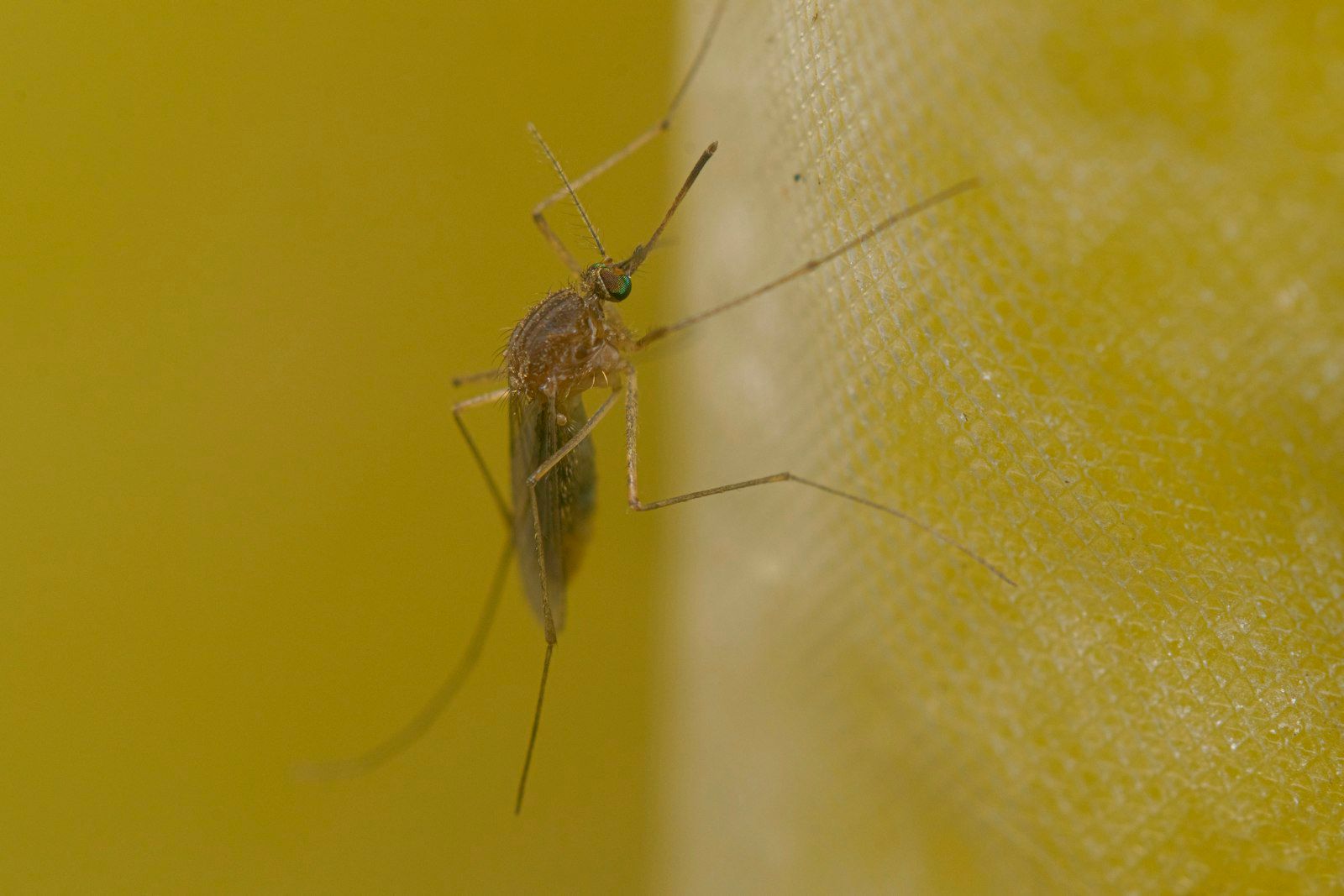
La Verpillière, Isère, released 2 million sterile male tiger mosquitoes on 4 June. It is the third French town to do so in 2026, and the cost is the part nobody is reporting. A clean look at the 2026 French sterile-mosquito map, and the cheque nobody has yet written.
La Verpillière, a commune in the Isère department, released 2 million sterile male tiger mosquitoes on the morning of Thursday 4 June. It is the third French town to be running a sterile-mosquito release in 2026, and the release happened in the same week that Santé publique France confirmed the tiger mosquito is now present in 83 of France's 96 metropolitan departments.
The operation was carried out by Terratis, the Montpellier-based firm that has become the most visible name in European sterile-insect production. The Ville de La Verpillière set out the start of the experiment on its own website. Actu.fr followed with regional coverage on 15 June. Neither the municipal notice nor the regional write-up surfaced the cost or any resident reaction. That absence is itself the most useful editorial fact. Ground-level sterile-mosquito releases in France are now being treated as routine municipal hygiene, not as a science story.
The technique in one paragraph
Sterile insect technique (SIT) works on a simple premise. Male tiger mosquitoes are reared in a factory, sterilised with X-ray ionising radiation, and released into the wild. Wild females mate with them; the eggs fail to hatch; the local population collapses over a few generations. The IAEA has been funding SIT programmes against agricultural pests since the 1960s. Adapting it to Aedes albopictus required new industrial engineering, and that engineering is now, in the form of Terratis, scaling.
The 2026 French map, in order
Three French towns are now running Terratis-operated SIT releases in 2026. Drawn from AFP coverage and the regional press:
- Toulouse (Haute-Garonne): 5 million sterile males released in May 2026, in and around the Terre-Cabade cemetery, with an 80% reduction target over two years.
- Brive-la-Gaillarde (Corrèze): 11 million released since May 2025. Per Terratis co-founder Clelia Oliva, half of the spring 2026 eggs collected in the release zone were sterile, with 90% projected by the end of summer 2026.
- La Verpillière (Isère): 2 million released on 4 June 2026. No reduction data yet, too soon.
The point of the French number is not that it competes with the global leaders. One Brazilian Wolbachia facility, for context, produces 100 million eggs a week. That is a different technique, on a different continent, at a different scale. The point is that sterile-mosquito releases in France are now small-town municipal, not national-laboratory.
What the press is and is not telling you
The local coverage of La Verpillière, Brive-la-Gaillarde, and Toulouse has been conspicuously brief on three points that matter.
First, cost. The Montpellier Malbosc trial, run since August 2025 across 31 release sites, costs roughly €70,000 for 100,000 males released twice a week. A single release of 2 million, if structured the same way, implies a six-figure seasonal budget. The La Verpillière town hall has not published the cheque.
Second, funding. Local mairies are paying. The regional health agency (ARS) is not. Stéphane Jouault, deputy mayor of Montpellier, told AFP: "We don't have the means to finance releases on the scale of an entire city." The same constraint applies in Isère, in Haute-Garonne, and in Corrèze. If France is going to run a national SIT programme, somebody is going to have to write a national cheque. So far, nobody has.
Third, regulation. Sterile mosquitoes fall in a regulatory "grey area", neither biocide nor GMO, in the framing of IRD entomologist Frederic Simard. The European approval pathway has not been written. Each French release is, in effect, a pilot running on the patience of a single municipal council.
The honest verdict
The Terratis factory now produces 1.5 million sterile male Aedes albopictus a week. Its two-year target is 40 million. Simard describes the technology as "iPhone 1.0 stage." It works. It is not yet finished.
That phrase is the most useful sentence in the week's coverage. It is honest in three directions at once. It concedes that the technique has been demonstrated in contained trials (the Brive-la-Gaillarde numbers are real). It concedes that regulators are a year or two behind the factory floor. And it concedes that SIT must be combined with other techniques, from Wolbachia to environmental management to personal protection, to work at a national scale.
What this means for an ordinary reader
For a person living in La Verpillière, Toulouse, Brive-la-Gaillarde, Montpellier, or any of the 83 metropolitan departments the tiger mosquito now calls home, the answer is the same one Clelia Oliva gave AFP for the broader strategy: "not to eradicate the species entirely, but to significantly and sustainably reduce their numbers."
That is also a fair description of what one well-tended garden at a time can do. The Terratis factory is a 40-million-a-week industrial bet. The municipal release is a 2-million-mosquito community bet. The garden, the gutter, the screen, and the repellent remain the personal bet. None of them, alone, is enough. Together, they are the answer that exists today, until a national cheque, a regulator, and a 90% reduction number arrive in the same room.
What we know
- La Verpillière (Isère) released 2 million sterile male tiger mosquitoes on Thursday 4 June 2026, carried out by Terratis. (Ville de La Verpillière; Actu.fr, 15 June 2026)
- The same Terratis-operated technique is currently running in Toulouse (5 million, May 2026) and Brive-la-Gaillarde (11 million since May 2025, ongoing).
- The Montpellier Malbosc trial (August 2025 onward) costs roughly €70,000 for 100,000 sterile males released twice weekly across 31 sites. (Phys.org / AFP, 16 June 2026)
- Terratis co-founder Clelia Oliva said 50% of spring 2026 eggs in the Brive-la-Gaillarde release zone were sterile, with 90% projected by the end of summer 2026. (Phys.org / AFP, 16 June 2026)
- IRD entomologist Frederic Simard described the technology as "iPhone 1.0 stage" and said the sterile-insect approach "needs to be combined" with other techniques. (Phys.org / AFP, 16 June 2026)
- Sterile mosquitoes fall in a regulatory "grey area", neither biocide nor GMO. (Phys.org / AFP, 16 June 2026)
- Stéphane Jouault, deputy mayor of Montpellier, told AFP his city "doesn't have the means to finance releases on the scale of an entire city." (Phys.org / AFP, 16 June 2026)
- Santé publique France confirmed on 17 June 2026 that the tiger mosquito is present in 83 of France's 96 metropolitan departments. (CNEWS / AFP / Sud Ouest / Le Parisien, 16-17 June 2026)
- One Brazilian Wolbachia facility produces 100 million Wolbachia-infected eggs per week. (Phys.org / AFP, 16 June 2026)
What to do
- For residents of the 83 French metropolitan departments where the tiger mosquito is now established: the technique is real but it is not yet at city scale. Personal protection (DEET- or picaridin-based repellent at peak biting times, long sleeves at dusk, screens on windows and doors) remains the dependable layer. The tiger mosquito's active window has expanded to May to November, so the protection is a five-month layer, not a one-week layer.
- For residents of La Verpillière, Toulouse, Brive-la-Gaillarde, or Montpellier: the SIT pilot in your city is real, but it is funded at the municipal level and is running at cemetery- or district-scale, not city-scale. Your garden, your gutters, and your screens still do the work. If a press release has not surfaced the release schedule, the published reduction target, and the budget line, the release is not yet a release.
- For anyone attending a public meeting about tiger mosquitoes in their commune (the kind the regional press has been flagging in Pérols and elsewhere): the question to ask your mairie is not "is the release coming?" but "what is the release schedule, what is the published reduction target, and what is the budget line?". A genuine release publishes all three. A press release that does not is not yet a release.
- For anyone reading from outside France: the same logic applies anywhere the tiger mosquito is established. The technique is portable, but no city in the world has yet replaced household protection with sterile-mosquito releases at city scale. Industrial sterile-mosquito releases and personal protection are complements, not substitutes.
Sources cited
- Ville de La Verpillière, "Début de l'expérimentation avec Terratis, le lâcher de moustique tigre mâle stérile". https://www.laverpilliere.fr/debut-de-lexperimentation-avec-terratis-le-lacher-de-moustique-tigre-male-sterile/
- Actu.fr, "Pourquoi cette commune de l'Isère lâche 2 millions de moustiques tigres dans la nature ?" (15 June 2026). https://actu.fr/auvergne-rhone-alpes/la-verpilliere_38537/pourquoi-cette-commune-de-l-isere-lache-2-millions-de-moustiques-tigres-dans-la-nature_64403981.html
- AFP via Phys.org, "Scaling up: Key French firm now breeds 1.5 million sterile mosquitoes a week" (16 June 2026). https://phys.org/news/2026-06-scaling-key-french-firm-sterile.html
- France 24, "Stériliser le moustique tigre : le pari incertain d'une protection industrielle" (16 June 2026). https://www.france24.com/fr/info-en-continu/20260616-st%C3%A9riliser-le-moustique-tigre-le-pari-incertain-d-une-protection-industrielle
- CNEWS / AFP, "Zika, chikungunya, dengue : la France recense déjà plus de 210 cas depuis début mai" (17 June 2026). https://www.cnews.fr/sante/2026-06-17/zika-chikungunya-dengue-la-france-recense-deja-plus-de-210-cas-depuis-debut-mai
- Le Parisien, "Moustiques, dengue, chikungunya, virus du Nil occidental : faut-il craindre une saison record ?" (16 June 2026). https://www.leparisien.fr/societe/sante/moustiques-dengue-chikungunya-virus-du-nil-occidental-faut-il-craindre-une-saison-record-16-06-2026-GKXA2IIQGNHXPKLSXBNTQFJVTI.php