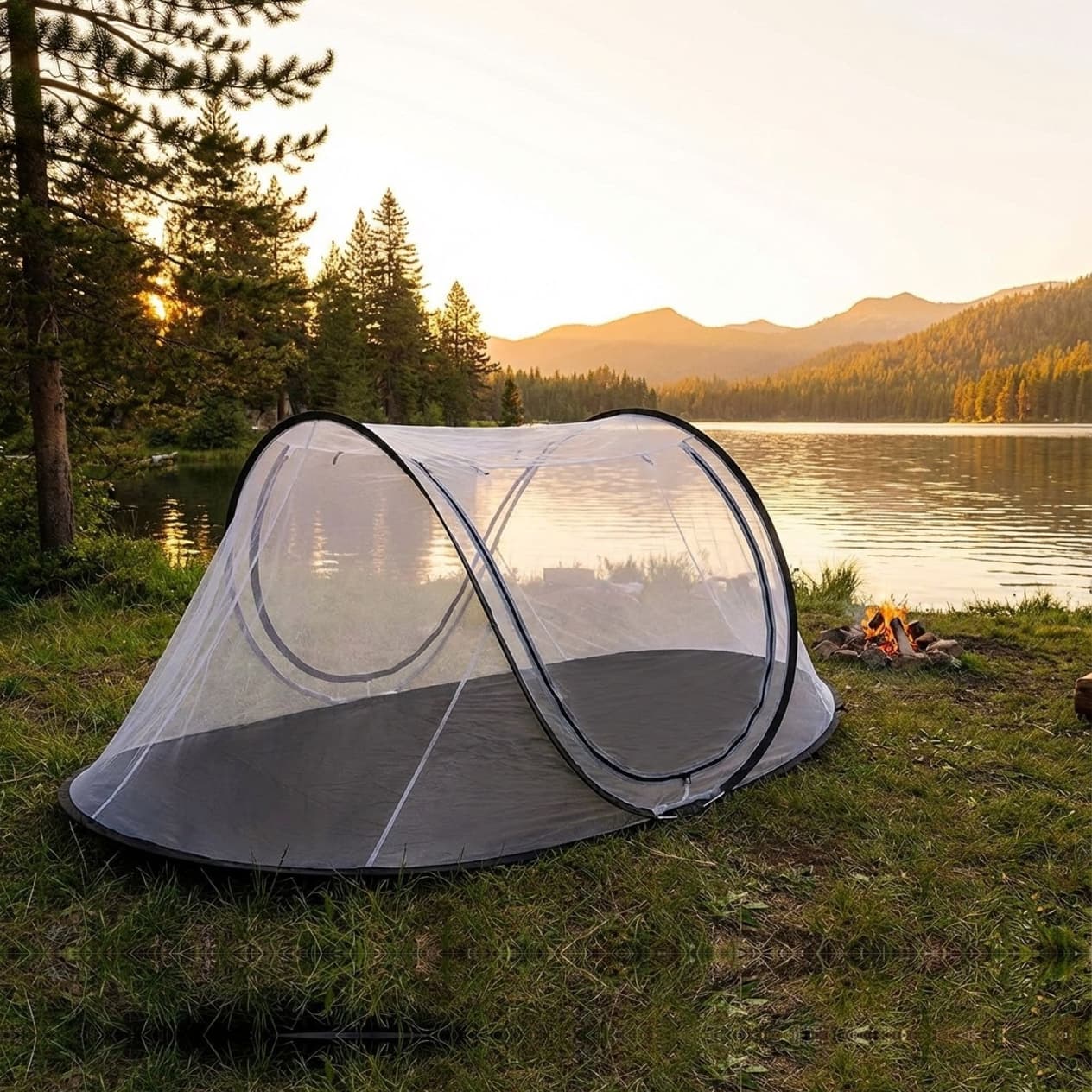
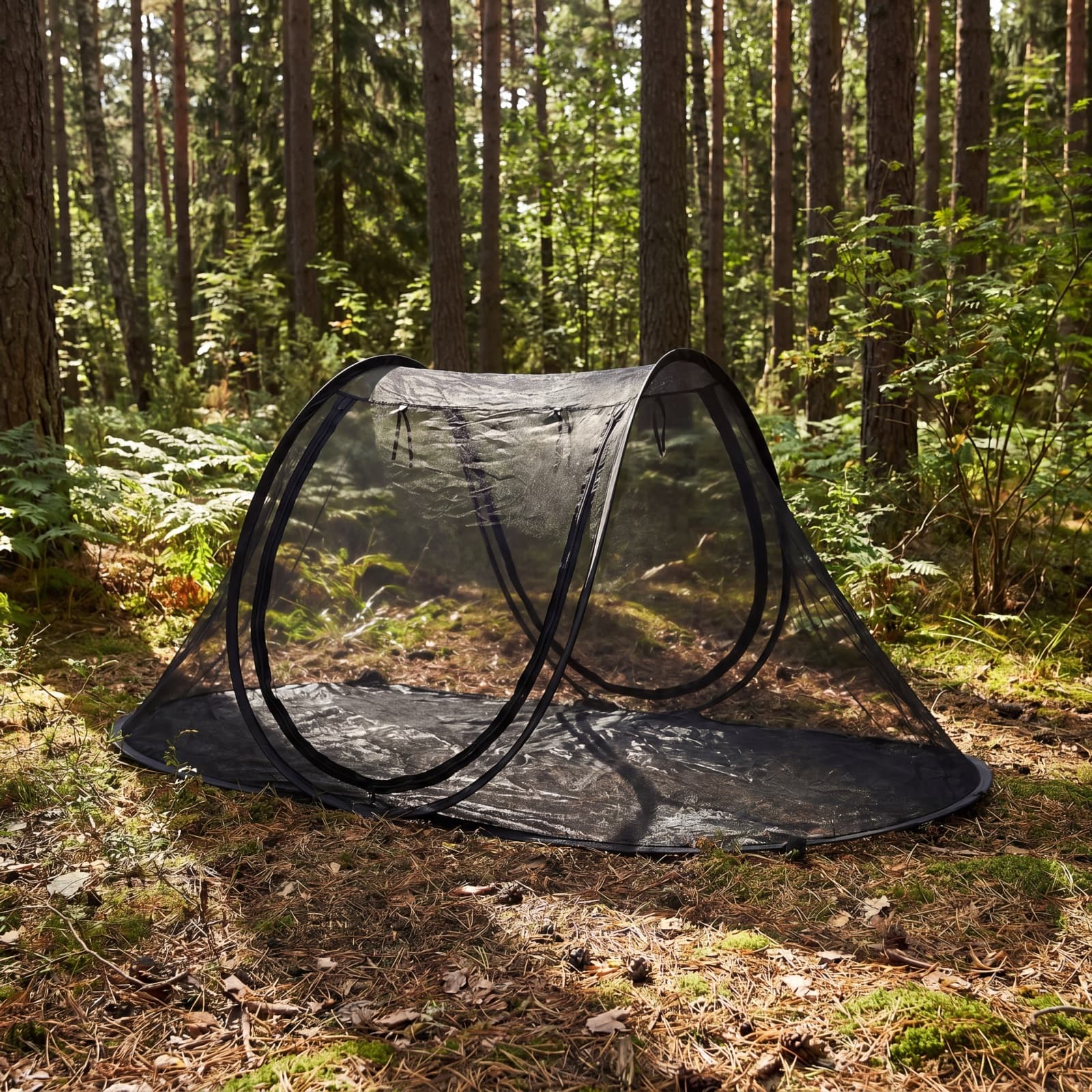
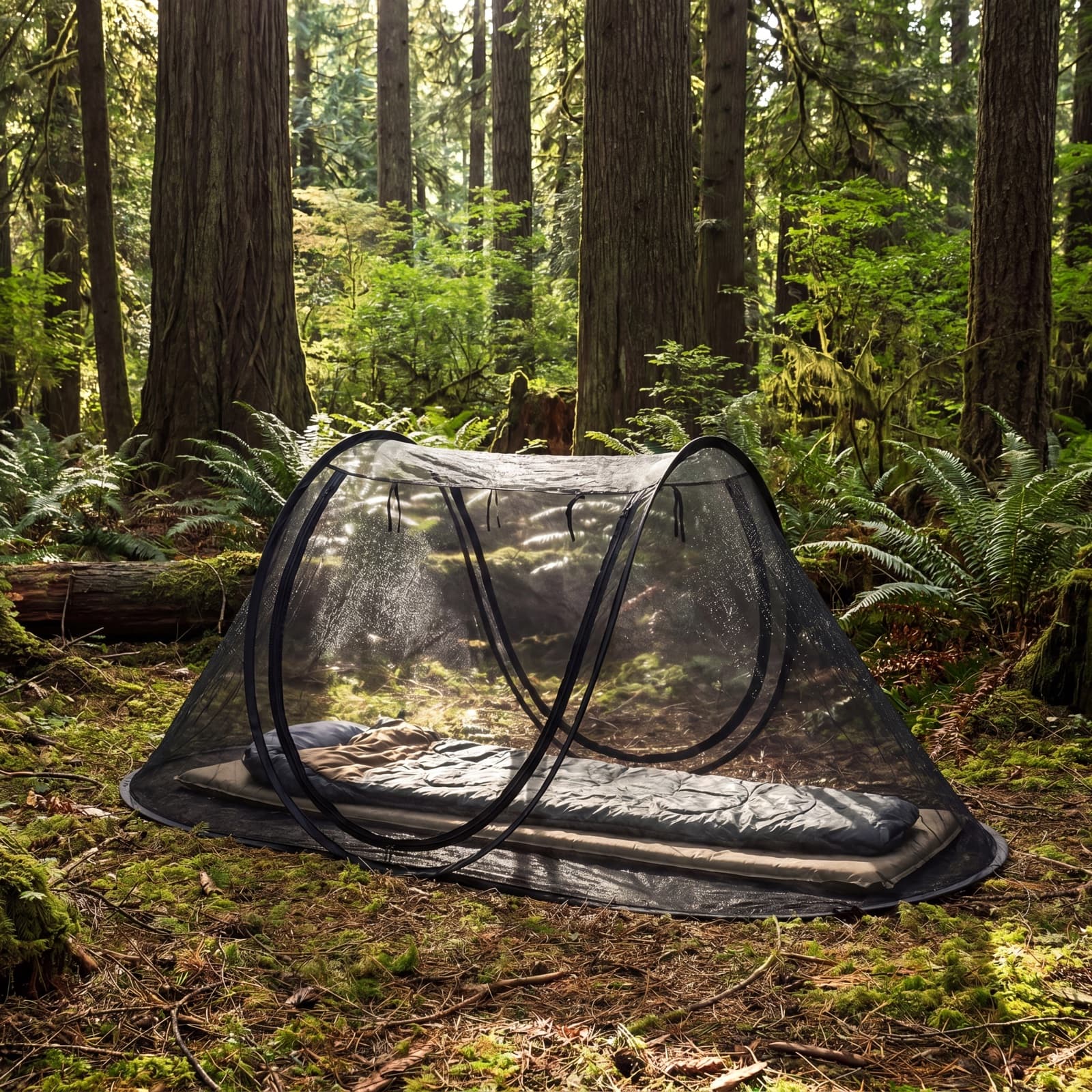
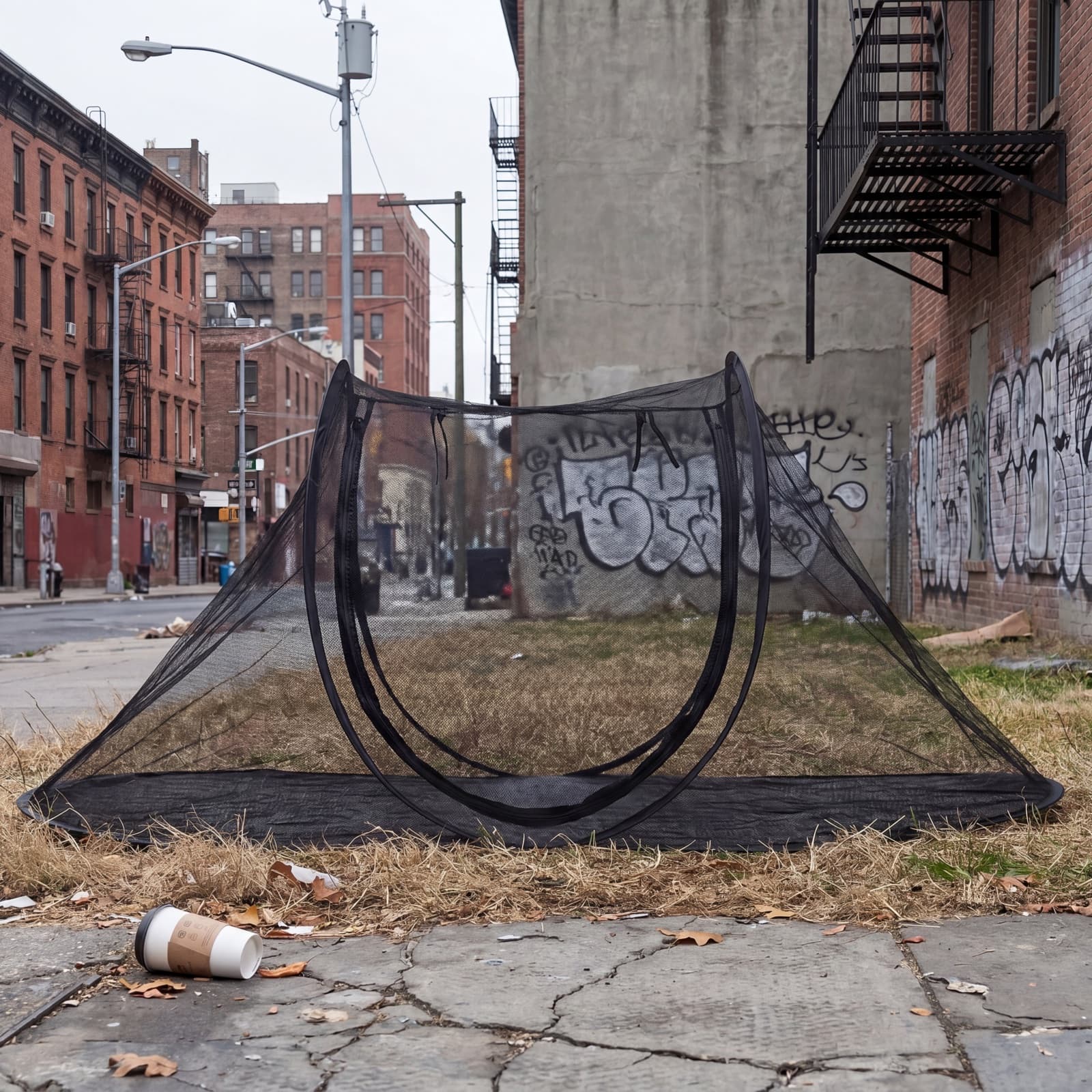
Mosticare Igloo, Freestanding Pop-Up Mosquito Tent
Pop it up anywhere, zip yourself in, sleep with nothing on the mesh.
- Pure physical barrier, zero chemicals, nothing on the mesh to breathe overnight
- Pops up self-supporting on any surface; sewn-in floor and full zip seal it on every side
- Three sizes (solo, two-person, baby); packs into a carry pouch with a quick-start card
A freestanding pop-up mosquito tent — an igloo that springs into shape in seconds, with a sewn-in mesh floor and a full-length zip door, so the barrier seals completely around you with no open hem for anything to find. The same 156-count polyester mesh used across the Mosticare range, here left completely untreated: zero chemicals, nothing on the mesh to breathe through a whole night inside. Three sizes — Uno (solo), Due (two-person), and Bambino (a baby's outdoor nap) — in white or black. Three-year effective lifecycle, European design.
Every other way to keep mosquitoes off a sleeper needs something to hang from: a hammock's ridgeline, a ceiling hook, the four corners of a bed. Out on open ground — a campsite, a forest floor, a rooftop, a patch of grass in a city park — there is nothing to hang from, and that is exactly where the Mosticare Igloo belongs. It is a self-supporting pop-up dome that springs into a fully enclosed mesh shelter in seconds, sits on its own sewn-in floor, and zips shut around the person inside. Three sizes cover the range: the Igloo Uno for the solo traveller, the Igloo Due for two, and the Igloo Bambino for a baby's nap in the open air.
What it is, exactly
The Igloo is a freestanding pop-up tent made entirely of mosquito mesh. There are no separate poles to thread and no anchor points to find: flexible sprung hoops are sewn into the mesh, so it springs open into a rigid dome on its own and folds flat back into a carry pouch. It stands unaided on grass, sand, decking, a tent or hut floor, or a city rooftop.
It is fully enclosed — a sewn-in mesh floor, mesh walls and roof, and a full-length zip door — so once you are inside and the zip is closed, the barrier seals on every side, with no open hem at the ground for anything to crawl or fly under. The mesh is the same 156-count polyester (25 holes per cm²) weave used across the Mosticare net range, knitted to the density that stops mosquitoes and most midges.
Three sizes share one design: the Igloo Uno (180 × 100 × 100 cm, 1.6 kg) for one adult, the Igloo Due (200 × 150 × 100 cm, 1.9 kg) for two or for one with gear kept inside, and the Igloo Bambino (140 × 90 × 90 cm, 1.2 kg) sized for a baby or toddler napping outdoors. Each packs into its own pouch and pops up in seconds. Colour: white or black.
Why this one carries zero chemicals
Most of the Mosticare range is factory-impregnated with permethrin, bound into the fibre, because a draped bed net sits at the edge of where you sleep. The Igloo is deliberately different, like the untreated Terrazza gazebo and the Volto head net: you are sealed *inside* it, often for a whole night, sometimes a baby is, so it carries no treatment at all.
The protection is purely geometric. The mesh is fine enough that the mosquito cannot pass, and there is nothing on it — no permethrin, no neurotoxic impregnation, no endocrine disruptors, no coating to breathe in the small enclosed volume of air around your face for eight hours. A full physical enclosure is its own complete defence: the Igloo simply keeps the insects on the outside of the mesh and leaves the air inside exactly as clean as the night around you.
Who it's for
The Igloo Uno is the solo traveller's shelter: backpackers, trekkers, festival campers, and anyone sleeping a night on open ground in tiger-mosquito country or, abroad, in malaria and dengue territory, where the bed is the floor and there is nothing to hang a net from. The Igloo Due takes two, or one person with a pack and boots kept inside the mesh.
The Igloo Bambino is the chemical-free choice for a baby's nap in the open air — a park lawn, a campsite, a beach, a garden — for parents who want a pure physical barrier with nothing on the mesh near their child at all. For a treated, WHO-standard infant net that drapes over a cot or pram, choose the Mosticare Bambino Dorme or Bambino Carello; the Igloo Bambino is the freestanding, zero-chemical alternative for supervised outdoor naps.
How to use it well
The Igloo is the fastest net in the range to deploy, because it is a pop-up.
- Pitch it: lift it from the pouch and let the sprung hoops spring it open into a dome. On hard or windy ground, peg or weight the corner tabs; on a tent or hut floor it stands as-is.
- Get in and close the zip all the way. The protection depends on it — an open zip is an open door.
- Keep the mesh intact. Because the Igloo is untreated, it relies entirely on a complete, unbroken enclosure; inspect it for snags or small tears before each trip and repair them with the Mosticare Net Repair Kit.
- It can be washed, gently — there is no permethrin to strip out, unlike the treated nets in the range, which must never be washed. Rinse, air-dry in shade, and never machine-tumble the sprung hoops.
- Fold it down by twisting the dome into a flat figure-of-eight and back into the pouch — a knack that takes one read of the quick-start card, then seconds thereafter.
- Expect a three-year effective lifecycle across normal seasonal use.
Every claim on this page is traceable to a standard or an independent test.
- No chemical treatment, the Igloo is a pure physical barrier. It carries no biocide and is not a treated article, so no biocidal-product authorization applies, by design, because you are sealed inside it for hours at a time.
- The same 156-count mesh weave (25 holes per cm²) used across the WHO-standard Mosticare net range, here deliberately left untreated.
- Fully enclosed, with a sewn-in mesh floor and a full-length zip door, so the barrier seals on every side with no open base.
- Designed in Europe for the climate-shifted European summer and the advancing Asian tiger mosquito.
- Three-year effective lifecycle under normal seasonal use.
Before you decide.
Is it treated with insecticide?
Does it have a floor?
How does it stand up — does it need poles or trees?
Which size should I choose?
Is the Bambino size safe for a baby?
Can I wash it?
White or black — does it matter?
Mosticare exists to protect people from the world's deadliest animal without poisoning the spaces they sleep in. The Igloo does it on open ground, where there is nothing to hang a net from — a complete, chemical-free enclosure you carry in a pouch and pop up wherever the night finds you.